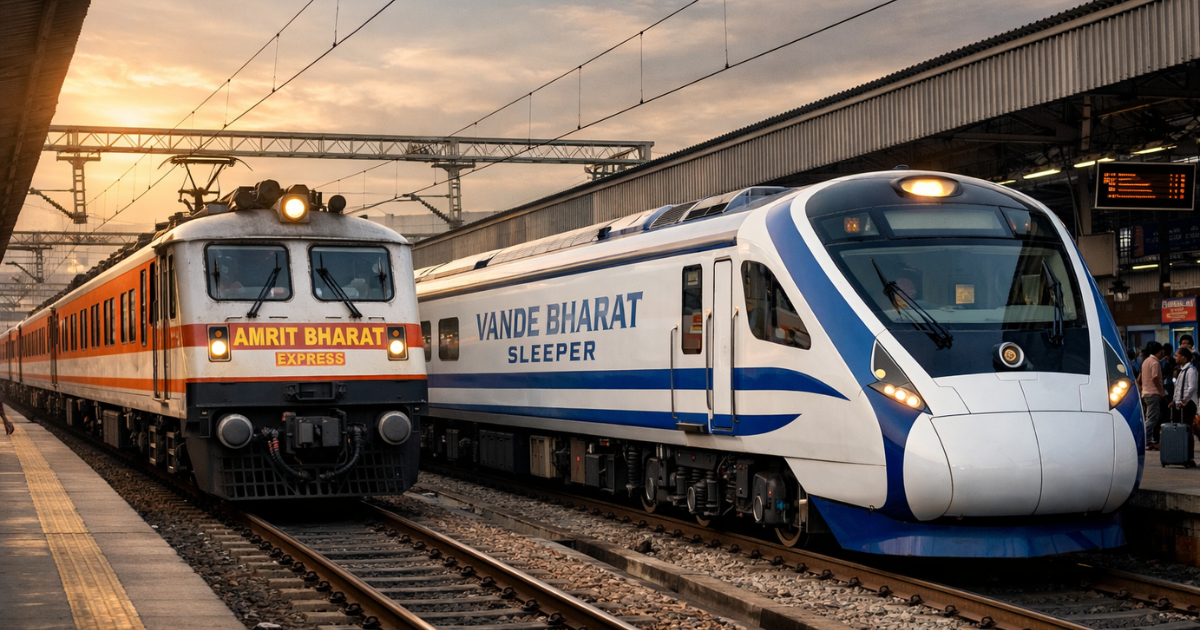
Indian Railways 2026: What You Should Know About the New Amrit Bharat and Vande Bharat Sleeper Trains
Indian Railways is entering a transformative phase in 2026, reshaping long-distance travel with the introduction of Amrit Bharat trains and the much-awaited Vande Bharat Sleeper services. Together, these two categories signal a strategic shift: faster trains for the masses and premium overnight travel for the growing middle class. As India expands its railway infrastructure at an unprecedented pace, these trains are designed to bridge comfort gaps, improve efficiency, and redefine how millions experience rail journeys.
A New Chapter in Rail Modernisation
For decades, Indian Railways has balanced scale with affordability, often at the cost of passenger comfort and punctuality. The reforms underway aim to correct that imbalance. By 2026, the focus is firmly on modern rolling stock, improved track infrastructure, and passenger-centric design. Amrit Bharat and Vande Bharat Sleeper trains are central to this vision, each catering to a different segment while sharing the goal of faster, safer, and more reliable travel.
Understanding the Amrit Bharat Train Concept
Amrit Bharat trains are positioned as the next-generation alternative to conventional mail and express trains. Unlike premium services, these trains are designed primarily for middle- and lower-middle-income passengers who rely on sleeper and unreserved travel for long-distance journeys. The emphasis is on durability, energy efficiency, and improved basic comfort rather than luxury.
The coaches in Amrit Bharat trains feature redesigned interiors with better ventilation, modern lighting systems, and ergonomically improved seating and sleeping arrangements. While air-conditioning is not standard across all coaches, the trains focus on smoother rides and reduced noise levels. Importantly, they are powered by push-pull locomotive systems, which allow faster acceleration and deceleration, helping reduce overall travel time without requiring high-speed tracks.
Speed, Capacity, and Accessibility in Focus
Amrit Bharat trains are expected to operate at speeds of up to 130 kmph, a significant improvement over many existing long-distance services. This upgrade is particularly important for densely populated routes where time savings of even a few hours can have a major social and economic impact. The higher passenger capacity of these trains is also aimed at easing congestion, especially during peak travel seasons and festival periods.
By prioritising affordability, Indian Railways is ensuring that modernisation does not exclude those who depend most on rail travel. Officials have repeatedly emphasised that Amrit Bharat is not a replacement for luxury trains but a mass-upgrade of the railway experience.
The Arrival of Vande Bharat Sleeper Trains
If Amrit Bharat trains represent inclusion, Vande Bharat Sleeper trains represent aspiration. Building on the success of the Vande Bharat Express, the sleeper variant is designed for overnight journeys covering distances of 800 to 1,200 kilometres. These trains are expected to enter regular service by 2026, marking India’s first indigenously developed semi-high-speed sleeper train.
The Vande Bharat Sleeper is engineered for comfort during long ноч journeys, with fully air-conditioned coaches, automatic doors, and aircraft-style bio-vacuum toilets. The berths are designed with privacy and personal space in mind, a significant improvement over traditional AC sleeper coaches. Enhanced suspension systems ensure minimal vibration, making sleep more comfortable even at higher speeds.
Technology and Safety at the Core
Both Amrit Bharat and Vande Bharat Sleeper trains incorporate advanced safety technologies. Automatic Train Protection systems, real-time monitoring, and improved braking mechanisms are integral to their design. Fire safety norms have been upgraded, and materials used in coach construction are more fire-retardant than older designs.
In the Vande Bharat Sleeper, onboard diagnostics continuously monitor critical components, allowing predictive maintenance and reducing the risk of breakdowns. This focus on technology aligns with Indian Railways’ broader push towards digitalisation and automation.
Economic and Regional Impact
The rollout of these trains is not just about passenger comfort; it has broader economic implications. Faster and more reliable trains improve connectivity between Tier-2 and Tier-3 cities, boosting tourism, trade, and labour mobility. Manufacturing these trains domestically under the “Make in India” initiative also strengthens the country’s railway manufacturing ecosystem, creating jobs and reducing dependence on imports.
Amrit Bharat trains, in particular, are expected to serve routes in eastern, central, and southern India where demand for affordable long-distance travel remains high. Vande Bharat Sleeper services are likely to be deployed on high-demand corridors connecting major metros and state capitals.
What This Means for Passengers in 2026
For passengers, the changes promise a more predictable and comfortable railway experience. Long journeys that once meant overcrowded coaches and unpredictable delays may become smoother and faster. While ticket pricing details are still being finalised, officials indicate that Amrit Bharat fares will remain close to existing sleeper-class tariffs, while Vande Bharat Sleeper tickets will be priced competitively against premium trains like Rajdhani and Duronto.
The Road Ahead for Indian Railways
Indian Railways in 2026 stands at a crossroads between tradition and transformation. The introduction of Amrit Bharat and Vande Bharat Sleeper trains reflects an attempt to modernise without alienating the vast majority of its users. If executed effectively, these trains could redefine rail travel by combining speed, comfort, and accessibility at scale.
As tracks are upgraded and new trains roll out, the success of this initiative will ultimately be judged not by speed alone, but by whether it delivers a more humane, reliable, and inclusive journey for India’s millions of daily rail passengers.
Add republicpost.in as a preferred source on google – click here
Last Updated on: Wednesday, January 28, 2026 1:12 pm by Rishidhar Reddy | Published by: Rishidhar Reddy on Wednesday, January 28, 2026 1:12 pm | News Categories: News
About The Author