LPG Supply Policy Sparks Nationwide Discussion
Government’s New LPG Supply Prioritization Explained
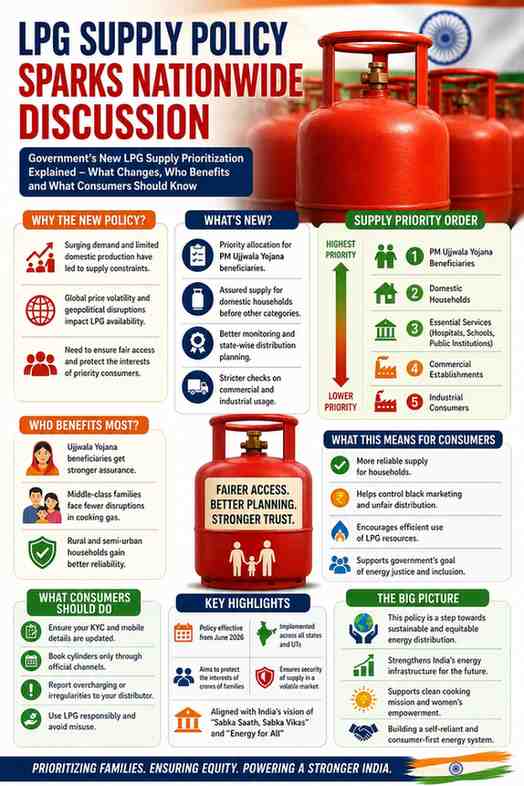
The government’s latest approach to liquefied petroleum gas (LPG) distribution has become a major topic of discussion across the country. As households, businesses, and industry stakeholders seek clarity on the new supply prioritization framework, the policy has sparked conversations about energy security, consumer needs, and resource management.
LPG plays a critical role in the daily lives of millions of Indians. It serves as a primary cooking fuel for households and is also widely used by commercial establishments such as restaurants, hotels, catering businesses, and small industries. Any change in LPG supply management therefore attracts significant public attention.
The new prioritization measures are aimed at ensuring that domestic consumers continue to receive uninterrupted access to cooking gas. While the policy has generated questions from various sectors, officials have emphasized that the primary objective is to safeguard essential household requirements and maintain stable distribution across the country.
Why LPG Remains Essential for Indian Households
Over the past several decades, LPG has become one of India’s most important household fuels. Government programs and increased distribution networks have expanded access to clean cooking fuel across urban and rural regions.
For many families, LPG provides a reliable and convenient alternative to traditional cooking methods. It is widely used for preparing daily meals and is considered an essential household utility.
Because of its importance, maintaining a consistent supply remains a key priority for policymakers. Any disruption can directly affect millions of consumers, making effective distribution management crucial.
Officials have repeatedly stressed that domestic consumers remain at the center of supply planning decisions. The latest policy reflects that broader objective of ensuring household needs are adequately met.
Understanding the New Prioritization Strategy
Supply prioritization refers to the process of allocating available LPG resources among different categories of consumers. During periods of increased demand, logistical challenges, or supply constraints, governments and energy providers may introduce measures to ensure that essential users receive priority access.
Under the current framework, household consumers have been placed at the forefront of distribution efforts. This means that domestic LPG requirements are expected to receive greater attention in supply planning and allocation decisions.
Authorities have stated that the approach is intended to strengthen supply reliability and minimize the risk of shortages affecting residential consumers.
The policy has generated widespread discussion because of its potential implications for commercial users who also depend on LPG for daily operations.
Impact on Hotels and Restaurants
The hospitality sector is among the industries most closely monitoring developments related to LPG distribution. Hotels, restaurants, cafes, and catering businesses rely heavily on cooking gas to support their operations.
Industry representatives have sought additional details regarding implementation timelines, alternative arrangements, and future supply mechanisms.
Business owners are evaluating how the policy may affect operational planning and fuel procurement strategies. Some establishments may explore additional energy options depending on local availability and cost considerations.
At the same time, industry experts note that commercial energy consumption patterns often differ significantly from household usage, requiring separate planning approaches and distribution systems.
The ongoing discussions highlight the importance of balancing consumer welfare with business continuity.
Energy Security and Resource Management
One of the key themes emerging from the LPG policy debate is energy security. Governments worldwide face the challenge of managing energy resources efficiently while ensuring that essential services remain accessible.
Energy security involves maintaining reliable access to fuel supplies despite fluctuations in demand, transportation challenges, or global market conditions.
LPG distribution is particularly sensitive because it affects both households and businesses. Policymakers must therefore consider a wide range of factors when making allocation decisions.
Experts note that prioritization policies are often designed to strengthen resilience within energy supply systems, particularly during periods of uncertainty or heightened demand.
By focusing on essential household needs, authorities aim to reduce the likelihood of disruptions that could impact daily life for millions of citizens.
Public Reactions and Nationwide Discussions
The policy has generated considerable discussion among consumers, businesses, and industry observers. Social media platforms, news outlets, and community forums have seen increased conversations regarding the implications of the new supply framework.
Many households have welcomed measures designed to ensure uninterrupted cooking gas availability. For families that rely entirely on LPG for meal preparation, stable supply remains a major concern.
Meanwhile, commercial stakeholders have expressed interest in understanding how future distribution arrangements will be managed.
The variety of perspectives reflects the broad role LPG plays across India’s economy and society. As a result, even relatively technical policy changes can become topics of widespread public interest.
Economic Implications of LPG Distribution Policies
Energy policies often have economic consequences that extend beyond the immediate fuel sector. Changes in distribution patterns can influence operational costs, supply chains, and business planning.
Restaurants, food service providers, and hospitality businesses closely monitor fuel expenses because energy costs can affect overall operating budgets.
At the same time, ensuring stable LPG availability for households contributes to consumer welfare and economic stability. Reliable access to cooking fuel supports daily life and reduces uncertainty for millions of families.
Economists note that balancing social priorities with commercial requirements is a common challenge in energy policy development.
The ongoing discussions surrounding LPG supply management illustrate the complexity of achieving that balance.
The Role of Infrastructure and Logistics
Behind every LPG cylinder delivered to a household or business lies a vast network of infrastructure and logistics operations. Storage facilities, transportation systems, distribution centers, and delivery networks all play important roles in ensuring fuel reaches consumers.
Managing such a large-scale system requires careful coordination between government agencies, energy companies, distributors, and retailers.
Supply prioritization policies often depend on the efficiency of these networks. Strong infrastructure can help minimize disruptions and improve distribution outcomes.
Industry observers suggest that continued investment in logistics and distribution capabilities will remain important for supporting long-term energy security objectives.
As demand for LPG continues to evolve, infrastructure development is expected to remain a key area of focus.
What Consumers Should Know
For most household consumers, the primary takeaway from the policy is that authorities are placing significant emphasis on maintaining reliable domestic LPG access.
Consumers are encouraged to stay informed through official announcements and updates from authorized distributors regarding supply arrangements and service schedules.
Experts also advise consumers to plan cylinder refills responsibly and avoid unnecessary panic purchasing, which can place additional pressure on distribution systems.
Reliable communication between authorities, distributors, and consumers remains essential for ensuring smooth implementation of any supply management strategy.
Looking Ahead
The nationwide discussion surrounding LPG supply prioritization highlights the importance of energy policy in everyday life. Cooking gas is not merely a commodity; it is an essential resource that supports households, businesses, and communities across the country.
As implementation details continue to emerge, stakeholders from various sectors will be closely monitoring developments and evaluating their impact. Policymakers, meanwhile, will likely continue balancing the needs of domestic consumers with broader economic and commercial considerations.
While debates surrounding energy allocation are likely to continue, the central objective of the current policy remains clear: ensuring reliable access to LPG for households while maintaining stability within the broader distribution system.
The conversation surrounding the new LPG framework demonstrates how energy decisions can influence public interest, economic planning, and national resource management. As India continues to strengthen its energy infrastructure and distribution capabilities, LPG policy will remain an important area of discussion for consumers and businesses alike.
Key Insights
- The government’s LPG supply prioritization policy is designed to ensure uninterrupted cooking gas availability for domestic consumers.
- Household users have been placed at the center of the distribution strategy, reflecting the essential role LPG plays in daily cooking and household needs.
- The policy has triggered nationwide discussions among consumers, businesses, and industry stakeholdersregarding its potential impact.
- Hotels, restaurants, and other commercial establishments are closely monitoring the policy, as LPG is a key fuel source for their operations.
- Energy security remains a major objective, with authorities focusing on maintaining stable supply and reducing the risk of shortages.
- LPG continues to be one of India’s most important household fuels, used by millions of families across urban and rural areas.
- The policy highlights the challenge of balancing residential demand with commercial requirements within a large and complex distribution network.
- Efficient logistics and infrastructure are critical to successful LPG distribution, including storage, transportation, and delivery systems.
- Industry experts believe responsible resource management is essential for ensuring long-term fuel availability and supply stability.
- Consumers are encouraged to follow official updates and refill cylinders responsibly to support smooth distribution operations.
- The discussion reflects broader concerns about energy management and resource allocation, which affect both economic activity and daily life.
- The LPG policy has become a significant public-interest topic because of its direct impact on households, businesses, and the overall energy ecosystem.
Last Updated on: Wednesday, June 3, 2026 4:24 pm by Pushkarini Annabathula | Published by: Pushkarini Annabathula on Wednesday, June 3, 2026 4:24 pm | News Categories: Latest
About The Author