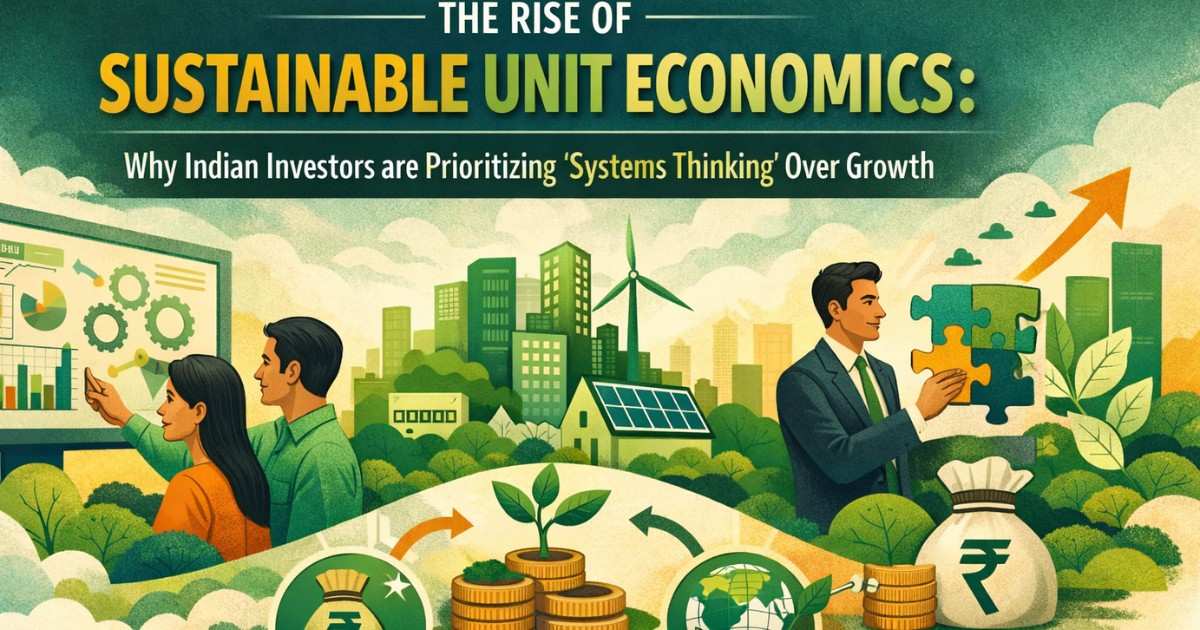
The Rise of Sustainable Unit Economics: Why Indian Investors Are Prioritizing Systems Thinking Over Growth
For much of the last decade, India’s startup ecosystem was powered by a single, seductive promise: grow fast, capture market share, and worry about profits later. Capital was abundant, valuations climbed rapidly, and founders were rewarded for scale rather than sustainability. That era is now decisively over. In its place, a quieter but more rigorous philosophy is taking root among Indian investors—one that places sustainable unit economics and systems thinking at the center of decision-making.
This shift has been shaped by a series of hard lessons. As global liquidity tightened and public markets turned unforgiving, the vulnerabilities of growth-at-all-costs models became impossible to ignore. High customer acquisition costs, heavy discounting, and operational inefficiencies were once masked by fresh funding rounds. Today, they are red flags. Indian investors, from venture capital firms to family offices and institutional funds, are increasingly asking a different set of questions: Does this business make money at the unit level? Are its systems resilient? Can it grow without burning disproportionate capital?
At the heart of this recalibration is the concept of unit economics—the profitability of a single transaction, customer, or product. For investors, positive unit economics are no longer a “nice-to-have” milestone deferred to the future; they are a prerequisite for serious capital deployment. Startups in sectors such as fintech, SaaS, logistics, and consumer brands are now expected to demonstrate clear contribution margins, disciplined customer acquisition strategies, and predictable lifetime value. The emphasis has moved from vanity metrics to fundamentals.
Yet what distinguishes the current phase from earlier cycles is the growing importance of systems thinking. Rather than evaluating isolated metrics in silos, investors are examining how different parts of a business interact and reinforce each other over time. Supply chains, technology infrastructure, pricing models, customer support, and talent strategy are being viewed as interconnected systems rather than standalone functions. Weakness in any one area is increasingly seen as a systemic risk rather than a temporary inefficiency.
This approach reflects a maturing investment mindset. Investors recognize that sustainable businesses are not built through aggressive top-line expansion alone, but through well-designed systems that can absorb shocks, adapt to regulatory changes, and maintain margins as they scale. In India, where market conditions can change rapidly due to policy shifts, infrastructure constraints, or consumer behavior, resilience has become a valuable currency.
Founders are feeling this change acutely. Pitch meetings that once revolved around total addressable market and rapid expansion plans now involve detailed discussions on cost structures, process automation, and operational leverage. Investors want to see how technology reduces marginal costs, how data improves decision-making, and how organizational design supports long-term efficiency. The question is no longer “How fast can you grow?” but “How intelligently can you grow?”
This transition has also been influenced by the experiences of Indian startups that reached scale without achieving profitability. Several high-profile companies discovered that large user bases and strong brand recognition did not automatically translate into sustainable businesses. For investors, these outcomes underscored the importance of designing systems that generate value consistently, not just intermittently during funding cycles.
Another driver of this shift is the growing participation of domestic capital. Indian family offices and long-term institutional investors tend to favor steady, compounding returns over speculative bets. Their influence has reinforced the focus on cash flows, governance, and operational discipline. Unlike short-term capital chasing rapid exits, this cohort is aligned with businesses that can endure and evolve over decades.
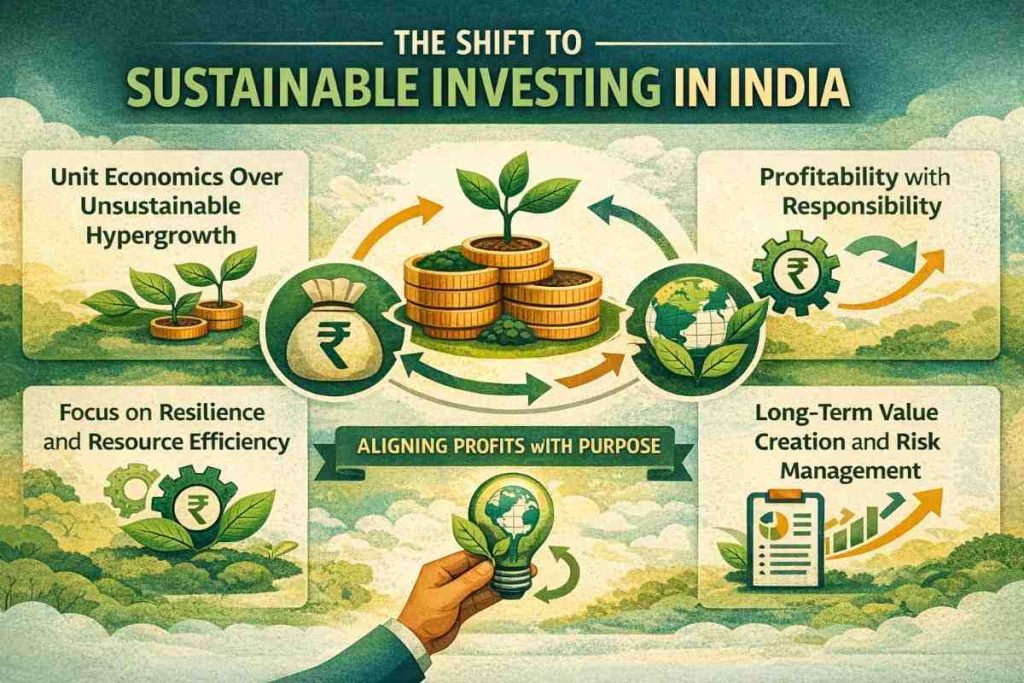
The renewed emphasis on systems thinking is also shaping sectoral preferences. Investors are increasingly drawn to businesses that solve structural problems rather than rely on arbitrage or heavy incentives. Climate-tech, manufacturing enablement, enterprise software, and deep-tech startups are benefiting from this lens, as their models often require thoughtful system design and offer clearer paths to sustainable margins.
Critically, this does not signal the end of ambition in India’s startup ecosystem. Instead, it marks a redefinition of ambition itself. Growth is still essential, but it is expected to be a byproduct of sound systems rather than the sole objective. The most compelling startups today are those that can demonstrate how each additional unit of growth strengthens, rather than strains, their underlying economics.
As Indian investors recalibrate their priorities, the message to founders is unmistakable. Capital will continue to flow, but it will favor businesses that understand themselves as systems—interconnected, measurable, and designed for durability. In an environment where capital is more discerning and markets are less forgiving, sustainable unit economics have emerged not just as a financial metric, but as a philosophy for building enduring companies.
In this new chapter of India’s entrepreneurial story, discipline is replacing exuberance, and design is overtaking improvisation. For investors and founders alike, systems thinking is no longer a theoretical ideal; it is fast becoming the defining principle of value creation in the Indian market.
Add republicpost.in as preferred source on google – Click Here
Last Updated on: Tuesday, January 27, 2026 11:21 am by Republic Post Team | Published by: Republic Post Team on Tuesday, January 27, 2026 11:21 am | News Categories: Startup, Trending
About The Author