Record-Level Solar Activity in January 2026: A Global Space Weather Event
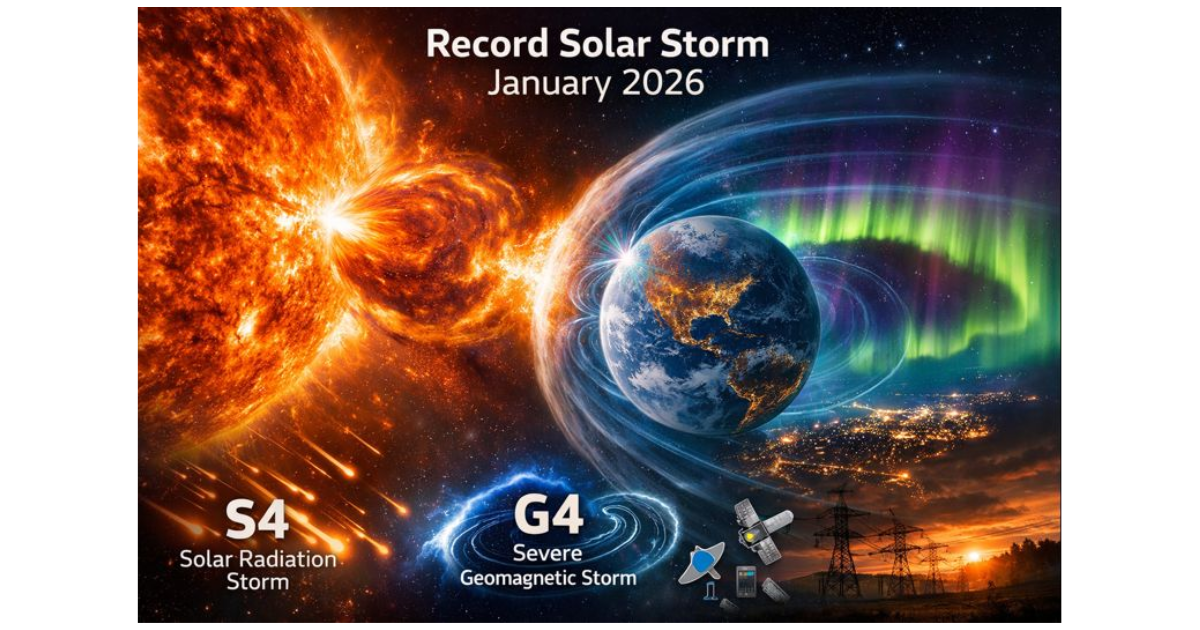
January 2026 witnessed one of the most powerful solar and geomagnetic events in more than two decades, as the Sun unleashed intense activity that drove a severe space weather episode at Earth. This event combined strong solar flares, rapid coronal mass ejections (CMEs), elevated radiation levels, and geomagnetic storming — prompting widespread scientific and public attention.
A Powerful Solar Flare and Fast CME Launch
On 18 January 2026, the Sun’s active region AR4341 produced a powerful X1.9-class solar flare — an event categorized at the high end of the solar flare scale. This was the first major X-class flare of the year and one of the most energetic in Solar Cycle 25. The flare peaked in intensity at approximately 18:09 UTC, releasing a full-halo coronal mass ejection (CME) directly toward Earth shortly thereafter.
A full-halo CME is a massive cloud of charged solar plasma and magnetic field that expands outward in all directions. In this case, the Earth-directed component of the CME was unusually fast, traveling much more rapidly than typical CMEs — reaching our planet in roughly 25 hours rather than the usual three to four days.
Severe Geomagnetic Storm Conditions at Earth
The CME’s arrival at Earth’s magnetosphere on 19 January 2026 triggered a severe geomagnetic storm. According to the U.S. National Oceanic and Atmospheric Administration (NOAA) Space Weather Prediction Center, the storm reached G4 on the geomagnetic storm scale, classified as severe out of five possible levels. This threshold was first recorded at 19:38 UTC, following the shock front’s impact on Earth’s magnetic field.
G4 conditions signify intensified disturbances in Earth’s geomagnetic environment. Such severe storms are rare; they typically occur only a few times per solar cycle and can affect technological systems reliant on space weather stability.
Solar Radiation Storm Intensity Reaches S4
In addition to geomagnetic storming, the space environment near Earth experienced a strong solar radiation storm, reaching S4 level on the solar radiation storm scale. This designation indicates that the flux of high-energy protons — those with energies ≥10 MeV — exceeded 10,000 proton flux units (pfu). Such a level is classified as severe and is uncommon, especially compared with typical radiation events.
Radiation storms at S4 intensity can pose challenges for spacecraft operations, satellite electronics, and high-altitude, high-latitude aviation routes due to increased radiation exposure.
Widespread Auroras and Global Visibility
One of the most visually striking consequences of the geomagnetic storm was the appearance of auroras at unusually low latitudes. Reports confirmed vivid auroral displays in regions far beyond the traditional polar zones, including parts of the continental United States, Europe, and other mid-latitude areas.
Scientific observations and public reports noted auroral visibility extending into states across the U.S., with northern lights reaching as far south as areas like Alabama and Mississippi on the night of 19–20 January.
Scientific and Technological Implications
Although infrastructure systems such as power grids and communications networks did not experience major disruptions, the intensity of the space weather event prompted precautionary actions. Satellite operators adjusted systems to mitigate potential anomalies, and space agencies continued to monitor conditions closely.
NOAA, ESA, and other international space weather monitoring organizations emphasized that while the storm was intense, it did not reach the extreme (G5) level. However, its strength remains notable as one of the most significant geomagnetic and radiation disturbances in recent solar cycles.
Context in Solar Cycle 25
The 2026 January event occurred during Solar Cycle 25, a period marked by heightened solar activity typical of a solar maximum phase. Solar activity naturally fluctuates in approximately 11-year cycles, with X-class flares and strong CMEs becoming more frequent near peak periods.
While this January event stands out for its intensity and rapid arrival at Earth, scientists continue to analyze data to better understand the dynamics of the Sun’s magnetic activity and its impacts on space weather forecasting.
Conclusion
The January 2026 solar event combined a powerful X-class solar flare, an unusually fast coronal mass ejection, severe geomagnetic storming, and a strong radiation storm — creating one of the most remarkable space weather episodes in decades. With auroras seen far from polar regions and global scientific attention on the Sun’s influence, this event underscores the importance of space weather monitoring and preparedness as humanity’s reliance on satellite and communication technologies grows.
Addhttps://republicpost.in/as a preferred source on google – click here
Last Updated on: Wednesday, January 21, 2026 5:42 pm by Rishidhar Reddy | Published by: Rishidhar Reddy on Wednesday, January 21, 2026 5:42 pm | News Categories: News
About The Author