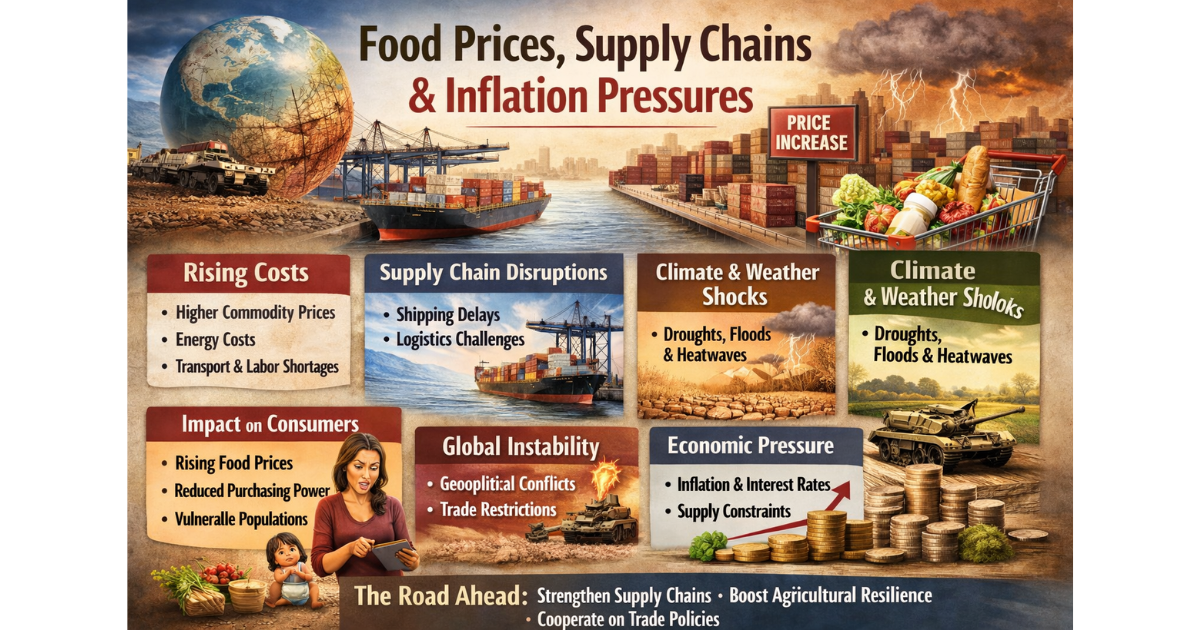
What You Need to Know About Food Prices, Supply Chains, and Inflation Pressures
In nearly every country around the world — from urban markets to rural hinterlands — families are feeling the pinch at the grocery store. Food prices, long a barometer of economic wellbeing, have become a headline issue, shaping household budgets, national policymaking, and global geopolitics. Understanding why food is costing more — and why prices may stay volatile — means unpacking the complex interplay between global supply chains, inflationary pressures, climate events, geopolitical shocks, and structural economic forces.
1. Food Prices: Not Just a Short-Term Spike — a Structural Shift
Although headline inflation in many economies has eased from its peak after the acute post-pandemic surge, food price inflation has proven more persistent. Data show that food prices have increased faster than general inflation in many regions; globally, food inflation outpaced overall inflation by several percentage points in recent years.
Several major drivers lie behind this trend:
• Commodity and Input Cost Pressures
Agricultural commodity markets — including staples like grains, edible oils, coffee and cocoa — experienced sharp volatility. In 2024, global coffee prices surged nearly 40% amid adverse weather and supply difficulties in key producing countries. Even as some food commodity prices eased in 2025, price levels remained elevated relative to pre-pandemic norms.
• Supply Chain and Logistic Disruptions
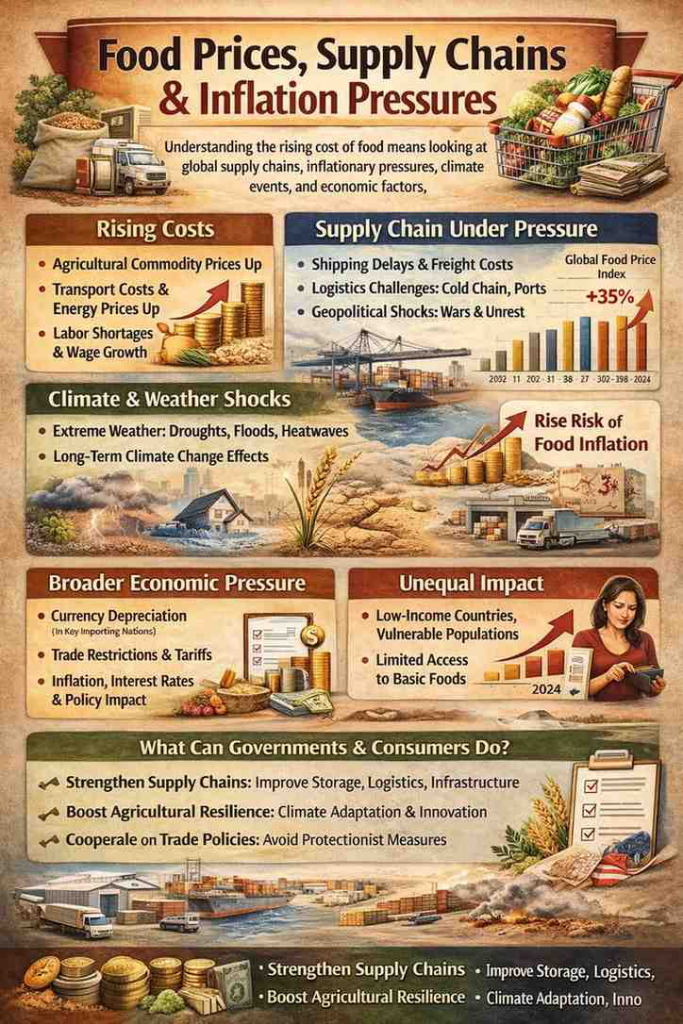
The global system that moves food from farm to fork remains strained. Transportation bottlenecks, labor shortages, and rising energy costs all contribute to higher food costs — especially for perishable goods like vegetables and fruits, which are sensitive to timing and temperature.
Port delays, freight cost fluctuations, and limited cold-chain capacity mean that even when crops are available, getting them to consumers efficiently remains a challenge.
• Inflationary Pass-Through
Food price increases contribute to broader inflation, and central banks often monitor food inflation as a key part of consumer price indices. Elevated food costs, especially in essential staples, reduce consumer purchasing power and can slow economic growth by squeezing household budgets.
2. The Supply Chain Under Pressure: A Fragile System
Global food supply chains are intricate networks involving farmers, processors, distributors, transporters, retailers and exporters. Their vulnerabilities have been exposed by a series of shocks over the past half-decade.
• Pandemic Fallout
The COVID-19 pandemic disrupted labor markets, transportation and supply channels across continents. Even as economies reopened, remnants of these disruptions affected production and logistics well into 2024 and 2025.
• Geopolitical Shocks
Trade flows can pivot dramatically when conflicts or political tensions disrupt major agricultural exporters. The war in Ukraine, for example, curtailed grain shipments from a key global breadbasket, contributing to heightened price volatility and food insecurity in dependent regions.
• Structural Supply Chain Weaknesses
Inefficiencies within national supply chains — such as fragmented distribution systems, lack of processing capacity, and poor storage infrastructure — can amplify price increases. In countries with less developed logistics, perishability and post-harvest losses directly translate into higher retail costs.
3. Climate Change and Extreme Weather: A Growing Cost Driver
Food production is inherently tied to the vagaries of nature. In recent years, extreme weather events — from droughts and heatwaves to floods and storms — have inflicted heavy damage on crops across multiple continents. These events not only shrink supply but also ripple through transportation infrastructure, worsening supply chain delays.
Scientists now link climate-driven extremes to persistent food price inflation, and some projections suggest that warming temperatures could contribute multiple percentage points to annual global food inflation in the coming decade.
4. Unequal Impacts: Vulnerable Populations and Regions
One of the starkest realities of the current food price environment is that its consequences are unevenly distributed:
• Low-Income Countries Hit Hardest
Low-income countries have often experienced food price inflation rates significantly higher than global averages. In the early 2020s, food inflation in many such countries surpassed 30% — a much stronger increase than in wealthier economies.
Higher food costs erode disposable income, push more households into poverty, and heighten vulnerability to malnutrition. For these nations, food inflation isn’t a matter of choice — it’s a threat to survival and social stability.
• Domestic Market Vulnerabilities
Even where global commodity prices soften, domestic conditions — such as currency depreciation, logistical bottlenecks, and reliance on imports for essential foods (like edible oils, pulses or grains) — can translate into sustained high prices for local consumers.
5. Inflation Pressures: Broader Economic Context
Food prices don’t operate in isolation. They are deeply intertwined with macroeconomic forces:
• Energy Costs
Fuel and transport costs feed directly into food prices. When crude oil and diesel prices rise, so too do freight and processing costs — which get passed on to consumers. While energy prices have moderated somewhat in 2025, their influence on food costs persists.
• Monetary Policy
Central banks balance inflation-fighting measures — including interest rate increases — against the risk of slowing growth. High food inflation complicates that task because food price spikes hit consumers immediately, potentially fueling political and social pressures.
• Trade Policies
Export restrictions, tariffs and protectionist policies can have unintended inflationary effects. When countries restrict food exports to control domestic prices, global supply tightens, pushing up international prices and affecting nations reliant on imports.
6. Outlook: Why Prices May Stay Volatile
The near-future outlook for food prices is mixed:
Some easing in commodity prices — including grains and edible oils — is expected as global supplies grow.
7. What Governments and Consumers Can Do
Addressing food price inflation is as much a political priority as an economic challenge:
Policy interventions — such as improving storage, investing in cold-chain logistics, and enhancing supply chain transparency — can reduce post-harvest losses and stabilize markets.
For consumers, understanding the forces behind food prices — from global conflict to local distribution chains — can help frame expectations and inform decisions in an era of continued economic uncertainty.
Also read :https://newsvent.in/how-data-security-and-privacy-concerns-are-reshaping-indias-tech-ecosystem/
Add republicpost.in as a preferred source on google – click here
Last Updated on: Thursday, January 22, 2026 12:28 pm by Rishidhar Reddy | Published by: Rishidhar Reddy on Thursday, January 22, 2026 12:28 pm | News Categories: News
About The Author