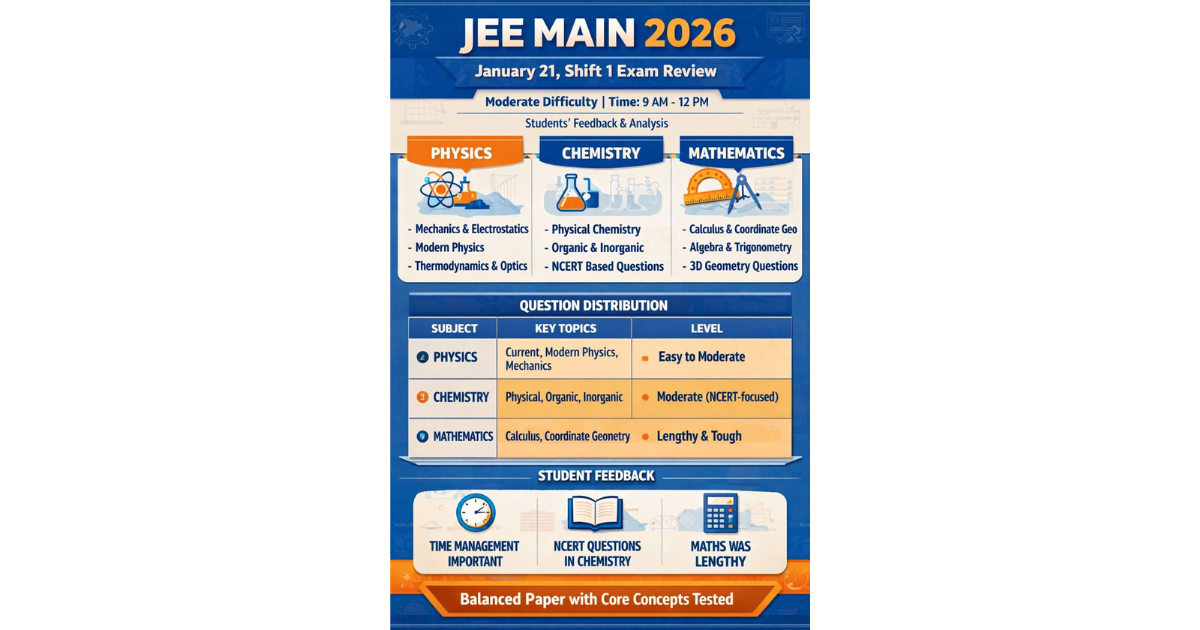
JEE Main 2026: In‑Depth Coverage of the January 21 Shift‑1 Question Paper
The National Testing Agency (NTA) conducted the JEE Main 2026 Session 1 Paper 1 on January 21, 2026, with the first shift running from 9 am to 12 pm. Across India, tens of thousands of engineering aspirants appeared for the BE/BTech entrance exam, designed to assess readiness in Physics, Chemistry, and Mathematics. Early post‑exam analyses and student feedback have now provided a credible, subject‑wise understanding of the paper’s content, difficulty level, and emerging trends.
Overall Difficulty and Student Reaction
Across reports, the January 21 Shift‑1 question paper was perceived as moderately challenging, with variation among the three subjects. Many candidates described the exam as balanced and fair but noted that time management was crucial due to lengthy calculations, especially in Mathematics and some parts of Chemistry.
Student reactions collected outside examination centers indicate that the paper was largely within the expected syllabus, without out‑of‑scope questions. Most problems tested conceptual understanding and application, rather than rote memorisation.
Subject‑Wise Breakdown
Physics – Conceptual and Formula‑Based
Most candidates found the Physics section to be easy to moderate in difficulty. The questions predominantly tested fundamental principles and formula application, rather than highly convoluted reasoning.
According to memory‑based feedback:
- Topics observed included Current Electricity, Modern Physics, Mechanics, Electrostatics, Thermodynamics, and Optics.
- Questions often required calculating numerical values or applying core concepts directly.
- Students reported a predictable pattern with no major surprises beyond standard syllabus expectations.
This aligns with broader feedback that Physics rewarded basic understanding and was scoring for well‑prepared candidates.
Chemistry – NCERT‑Oriented but Demanding
Chemistry was described by many students as balanced yet demanding.
Key trends from memory‑based responses show:
- A significant number of questions came from Physical Chemistry, with a solid mix of numericals and conceptual problems.
- Organic and Inorganic Chemistry both contributed meaningfully, with inorganic questions often being directly based on NCERT text.
- A few questions involved multi‑step reasoning — especially in organic reaction mechanisms and conversions — which increased the time required for accurate answers.
Overall, Chemistry was perceived as score‑friendly for aspirants with strong NCERT foundations, though some candidates noted that depth in reaction logic and molecule synthesis made select questions more time‑consuming.
Mathematics – Lengthy and Time‑Intensive
By consensus, Mathematics emerged as the most time‑consuming section of the JEE Main paper. While not uniformly the toughest conceptually, the mathematics questions frequently involved extended multi‑step calculations and spatial reasoning.
Memory‑based feedback identified key topic weightage:
- Calculus (Integration and differentiation applications)
- Coordinate Geometry
- Algebra
- Trigonometry & Vectors
- 3D Geometry
Students reported that time taken to solve multi‑layer problems in vectors, coordinate systems, and calculus components significantly influenced their ability to finish the paper within the allotted time.
Topic Highlights and Weightage Trends
Based on aggregated feedback from students and experts, the likely distribution (memory‑based) of questions in each subject was as follows:
| Subject | Key Topics | Nature of Questions |
|---|---|---|
| Physics | Current Electricity, Modern Physics, Mechanics, Electrostatics, Thermodynamics, Optics | Core concepts, formula application |
| Chemistry | Physical Chemistry, Organic & Inorganic Chemistry | Mix of NCERT‑driven and reasoning queries |
| Mathematics | Calculus, Coordinate Geometry, Algebra, Trigonometry & Vectors, 3D Geometry | Lengthy problem solving, multi‑step questions |
(Topic list based on memory‑based reports from students immediately after the exam)
Strategic Takeaways for Future Aspirants
- Time Management is Critical: Due to lengthy calculations — especially in Mathematics — pacing across all three sections was cited as essential to scoring well.
- NCERT Focus Beneficial: Chemistry performance correlated with preparedness in NCERT fundamentals, especially inorganic and physical chemistry.
- Strong Basics in Physics Paid Off: Physics questions largely stayed within standard frameworks, comforting aspirants who focused on concept clarity.
Conclusion
The JEE Main 2026 January 21 Shift‑1 examination delivered a moderately challenging yet fair assessment of candidates’ readiness for engineering entrance. With balanced subject coverage and emphasis on core concepts over esoteric tricks, the paper reflected the examination’s objective of rewarding conceptual clarity, accuracy, and strategic time management.
Results and official answer keys from the National Testing Agency are expected in the coming days; however, initial student and expert responses already provide meaningful insights for aspirants preparing for subsequent shifts.
Also read:https://republicpost.in/record-level-solar-activity-in-january-2026-a-global-space-weather-event/
Addhttps://republicpost.in/ as a preferred source – click here
Last Updated on: Wednesday, January 21, 2026 5:51 pm by Rishidhar Reddy | Published by: Rishidhar Reddy on Wednesday, January 21, 2026 5:51 pm | News Categories: News
About The Author