Income Tax Refund Delays & Processing Backlog: A Detailed Report
New Delhi — A growing backlog in processing income tax returns (ITRs) for the current assessment year is resulting in widespread delays in issuing refunds to taxpayers, according to official data and industry reporting. While refund timelines historically ranged from a few weeks to a couple of months after filing and verification, many filers are now waiting several months or longer for refunds to be credited to their accounts.
Large-Scale Backlog in Return Processing
As of early January 2026, the Income Tax Department’s Centralised Processing Centre (CPC) data shows that millions of ITRs remain unprocessed, directly affecting the pace of refund disbursements:
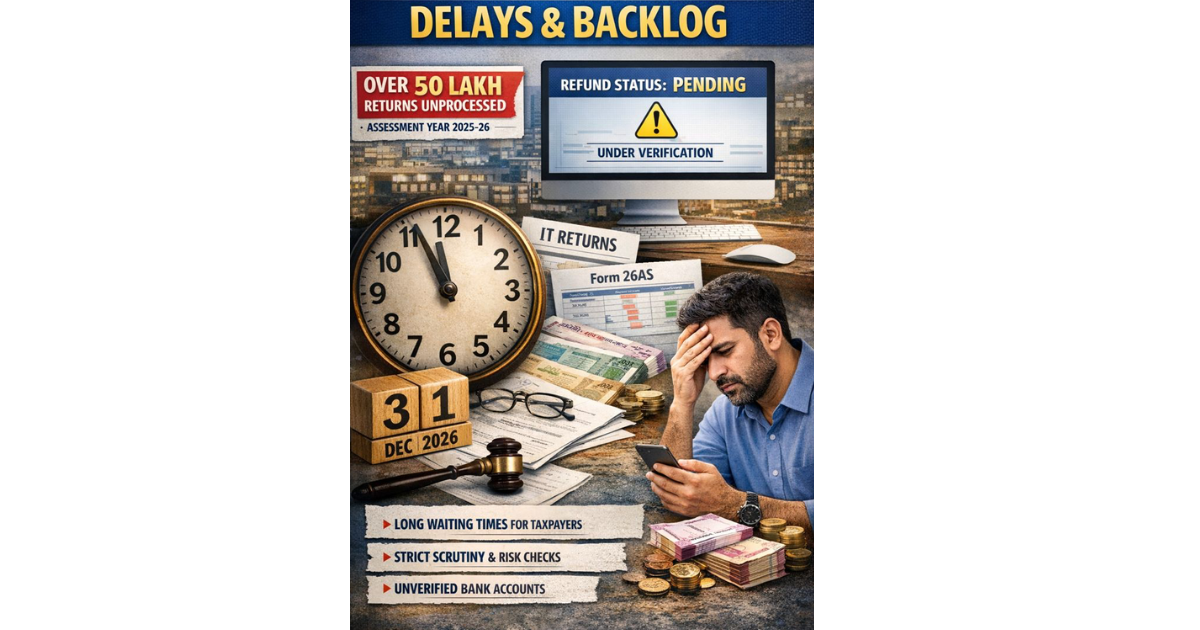
- Over 50 lakh returns for Assessment Year (AY) 2025-26 remain unprocessed, despite total filings approaching 9 crore.
- Independent assessments suggest that the unprocessed return count may be as high as 60-61 lakh as of early January 2026, with many of these returns linked to pending refunds.
Under the Income-tax Act, the tax department has until December 31, 2026 to complete processing of returns filed for FY 2024-25 (AY 2025-26), even when refunds are due — a statutory window that the department is currently utilising fully without breaching legal timelines.
Primary Causes of Delay
Tax experts and data released by financial news outlets point to several factual factors contributing to the slowdown:
1. Enhanced Verification and Risk Checks:
The income tax system’s automated filters are now applying stricter risk-based checks and data cross-verificationsthan in previous years. Returns exhibiting mismatches — especially with Form 26AS, the Annual Information Statement (AIS), or Tax Information Statement (TIS) — are pulled into manual or detailed scrutiny, slowing automated processing.
2. Data Mismatches and Compliance Alerts:
Mismatches in TDS/TCS credits, discrepancies in income reporting, and inconsistencies in high-value transactions are among the most common triggers for extended processing. Automated compliance alerts (sometimes described as the “risk management framework” or “NUDGE” alerts) have also increased the volume of flagged returns requiring corrective action or manual review before refunds can be processed.
3. Technical and Administrative Factors:
Issues including unverified returns, non-pre-validated bank accounts, and structural changes in ITR forms or portal upgrades have added to the department’s workload. Refunds cannot be released unless bank account details are validated and linked to a taxpayer’s PAN.
Impact on Refund Issuance
While some taxpayers receive refunds within the expected window of 20–45 days after filing and verification, a significant cohort — particularly those with complex filings or large claims — are experiencing extended delays. These delays coincide with broader trends in tax collections:
- Recent data indicates that total income tax refunds issued up to late 2025 were substantially lower than in the previous year, even amid higher cumulative tax collections.
However, a decline in refund volume does not necessarily indicate that refunds will not be issued; rather, it reflects shifting patterns in net tax liability and enhancements in refund-verification practices.
Legal and Interest Implications
Under Section 244A of the Income-tax Act, the department is required to pay interest on delayed refunds at a prescribed rate, typically 0.5% per month, but only on delays that are not attributable to taxpayer actions (such as non-verification or incorrect details). Interest is not payable in all scenarios, such as certain self-assessment adjustments or where refunds are below a specified minimum.
Taxpayers whose refunds are pending beyond the expected timelines are encouraged to verify their ITR status, ensure that all personal and bank details are correctly updated on the tax portal, and respond to any official alerts for revisions before the statutory processing window ends.
Outlook and Expectations
The department’s expanded use of data analytics to improve the accuracy of refund calculations has improved compliance outcomes but has also extended processing times, creating a temporary surge in backlog. With the statutory deadline for processing AY 2025-26 returns falling in December 2026, many refunds are likely to be issued throughout the year as processing catches up with the backlog.
For taxpayers, the current delay cycle — while unprecedented in recent years — remains within legal norms and is driven by systematic enhancements, data reconciliation practices, and a larger-than-expected volume of filings requiring detailed review.
Also read : https://republicpost.in/current-facts-casualty-figures/
Add republicpost.in and click here
Last Updated on: Tuesday, January 20, 2026 11:51 am by Rishidhar Reddy | Published by: Rishidhar Reddy on Tuesday, January 20, 2026 10:49 am | News Categories: News
About The Author