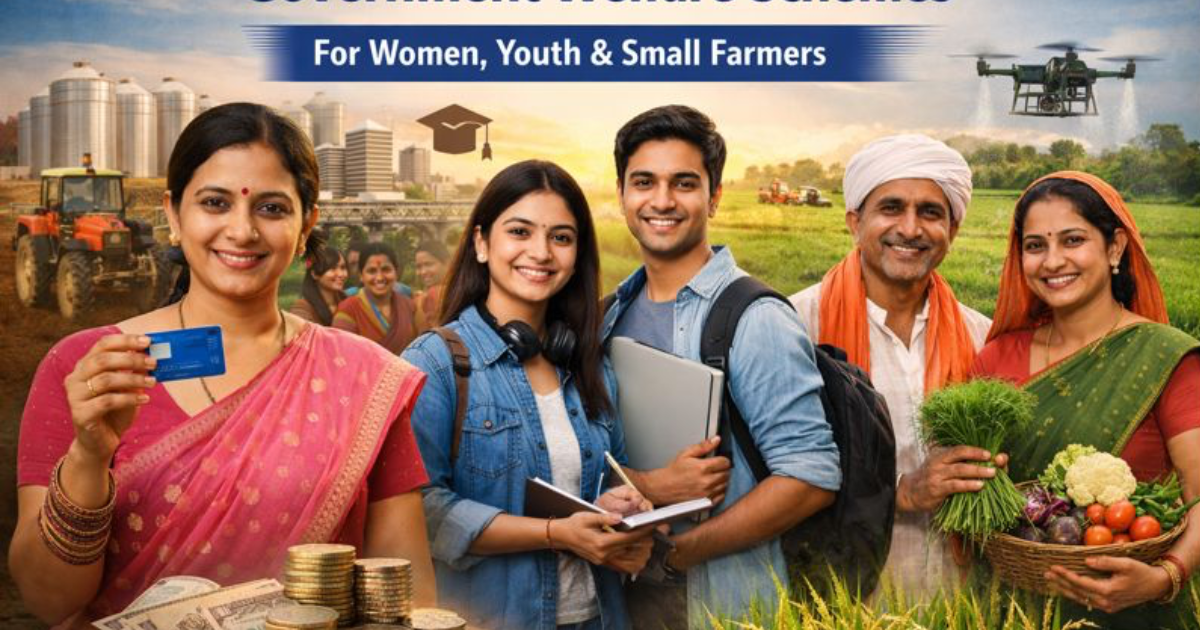
What You Need to Know About Government Welfare Schemes Aimed at Women, Youth, and Small Farmers
As India navigates economic transitions shaped by inflation pressures, job market shifts, and climate-linked agricultural risks, government welfare schemes aimed at women, youth, and small farmers continue to play a critical role in supporting livelihoods and promoting inclusive growth. From direct income support and skill development to health, education, and agricultural security, these schemes form the backbone of the country’s social protection framework.
With both the Union government and states expanding and refining welfare outreach, understanding how these initiatives work — and who they are designed to help — has become increasingly important.
Strengthening Economic Security for Women
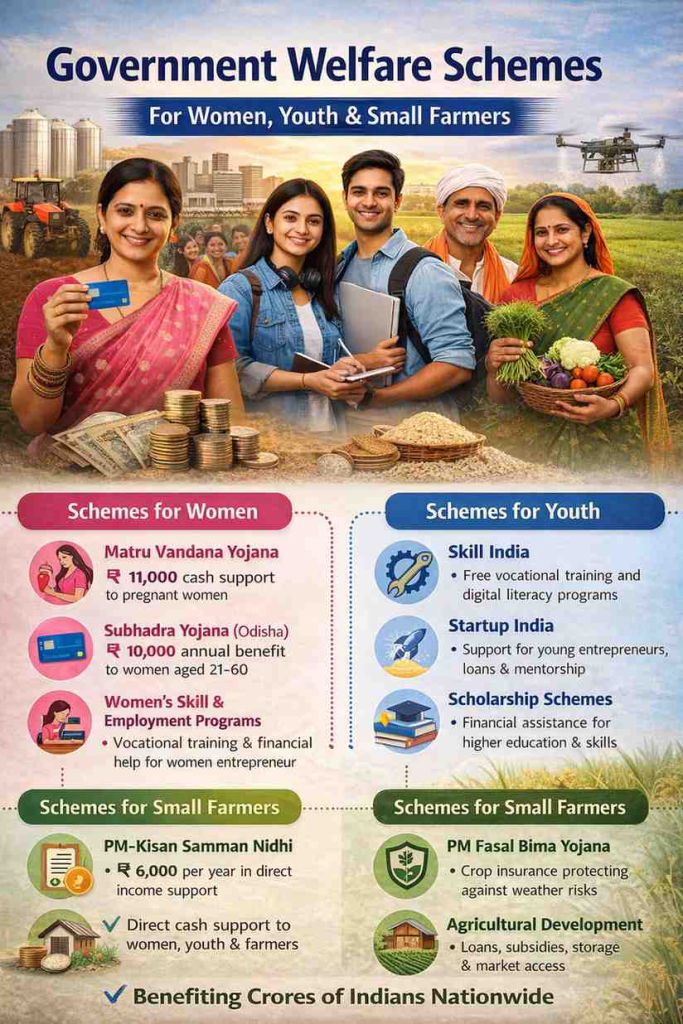
Women-focused welfare schemes in India have evolved beyond traditional social assistance, placing stronger emphasis on financial independence, health security, and workforce participation. Central schemes such as the Pradhan Mantri Matru Vandana Yojana provide direct cash assistance to pregnant and lactating women, aimed at improving nutrition, maternal health, and early childcare outcomes. By offering financial support in stages, the scheme seeks to reduce the economic burden associated with childbirth, particularly for women from economically weaker households.
At the state level, governments have rolled out large-scale direct benefit transfer programs that offer annual or monthly financial assistance to women within defined age and income brackets. These schemes, now active in states such as Odisha, Maharashtra, Haryana, and Jharkhand, are increasingly linked to bank accounts and digital platforms. Officials say the focus on direct transfers has reduced leakages while also promoting financial inclusion, with many women opening bank accounts for the first time.
Beyond income support, welfare initiatives also address long-term empowerment through skill development and employment. Programs under the National Rural Livelihood Mission and women-centric entrepreneurship initiatives are enabling women to start small enterprises, join self-help groups, and access institutional credit. In urban and semi-urban areas, industrial clusters and textile parks supported by government incentives are emerging as important employment hubs for women workers.
Youth Welfare Schemes and the Employment Challenge
India’s demographic profile, with a large and growing youth population, has placed job creation and skill development at the centre of policy planning. Government schemes aimed at young people focus on bridging the gap between education and employment while encouraging entrepreneurship and innovation.
Skill development initiatives aligned with industry needs are expanding through national programs that offer vocational training, digital skills, and certification courses. These are particularly targeted at rural and semi-urban youth, where access to private training institutions remains limited. The government has also increased support for startups and self-employment through credit-linked schemes, mentoring platforms, and simplified compliance frameworks.
Education-linked welfare continues to remain a priority, with scholarship programs supporting students from low-income families to complete higher education and professional courses. Officials argue that sustained investment in education and skills is essential to harness the demographic dividend, especially as traditional employment sectors undergo structural changes.
Income Support and Risk Protection for Small Farmers
Small and marginal farmers, who form the majority of India’s agricultural workforce, remain highly vulnerable to income volatility caused by weather events, rising input costs, and market fluctuations. Government welfare schemes aimed at this group focus on income support, risk mitigation, and infrastructure development.
The Pradhan Mantri Kisan Samman Nidhi scheme continues to provide annual financial assistance to eligible farmers through direct bank transfers. While the amount is modest, policymakers view it as an essential income cushion that helps meet basic farming expenses. Complementing this are crop insurance programs that protect farmers against losses due to natural calamities, pests, and diseases, reducing the financial shock of failed harvests.
In recent years, attention has also shifted towards strengthening agricultural infrastructure. Investments in rural storage facilities, cold chains, and market access platforms aim to reduce post-harvest losses and enable farmers to secure better prices for their produce. Digital platforms are increasingly being used to connect farmers directly with buyers, cutting down dependence on intermediaries.
Recognising the Role of Women in Agriculture
Women farmers, often under-recognised despite their significant contribution to agriculture, are receiving targeted attention through specialised schemes. These initiatives provide access to credit, training in modern farming techniques, and participation in farmer producer organisations. By focusing on women-led collectives, the government aims to improve productivity while also enhancing decision-making power at the household and community levels.
Officials note that empowering women in agriculture has broader social benefits, including improved nutrition, education outcomes, and financial stability for rural families.
Impact on the Ground and Implementation Challenges
On the ground, welfare schemes have enabled many beneficiaries to stabilise incomes, invest in education, and start small businesses. Stories from rural districts highlight how access to training, credit, and consistent financial support has helped families move away from subsistence livelihoods.
However, challenges persist. Awareness gaps, digital access issues, and administrative delays continue to affect scheme delivery in some regions. Experts stress the need for stronger local outreach, simplified application processes, and responsive grievance redressal mechanisms to ensure that benefits reach all eligible citizens.
Looking Ahead
Government welfare schemes aimed at women, youth, and small farmers remain central to India’s development strategy. As these programs evolve, their effectiveness will depend not only on budgetary allocations but also on efficient implementation, transparency, and adaptability to local needs. With continued policy
Recognising the Role of Women in Agriculture
Women farmers, often under-recognised despite their significant contribution to agriculture, are receiving targeted attention through specialised schemes. These initiatives provide access to credit, training in modern farming techniques, and participation in farmer producer organisations. By focusing on women-led collectives, the government aims to improve productivity while also enhancing decision-making power at the household and community levels.
Officials note that empowering women in agriculture has broader social benefits, including improved nutrition, education outcomes, and financial stability for rural families.
Impact on the Ground and Implementation Challenges
On the ground, welfare schemes have enabled many beneficiaries to stabilise incomes, invest in education, and start small businesses. Stories from rural districts highlight how access to training, credit, and consistent financial support has helped families move away from subsistence livelihoods.
However, challenges persist. Awareness gaps, digital access issues, and administrative delays continue to affect scheme delivery in some regions. Experts stress the need for stronger local outreach, simplified application processes, and responsive grievance redressal mechanisms to ensure that benefits reach all eligible citizens.
Looking Ahead
Government welfare schemes aimed at women, youth, and small farmers remain central to India’s development strategy. As these programs evolve, their effectiveness will depend not only on budgetary allocations but also on efficient implementation, transparency, and adaptability to local needs. With continued policy focus and institutional reforms, welfare initiatives are expected to play a key role in promoting inclusive and sustainable growth in the years ahead.
Add republicpost.in as a preferred source on google – click here
Last Updated on: Friday, January 23, 2026 6:21 pm by Rishidhar Reddy | Published by: Rishidhar Reddy on Friday, January 23, 2026 6:21 pm | News Categories: News
About The Author