AI-Based Weather Forecast Services to Deliver More Accurate Monsoon Updates Across India
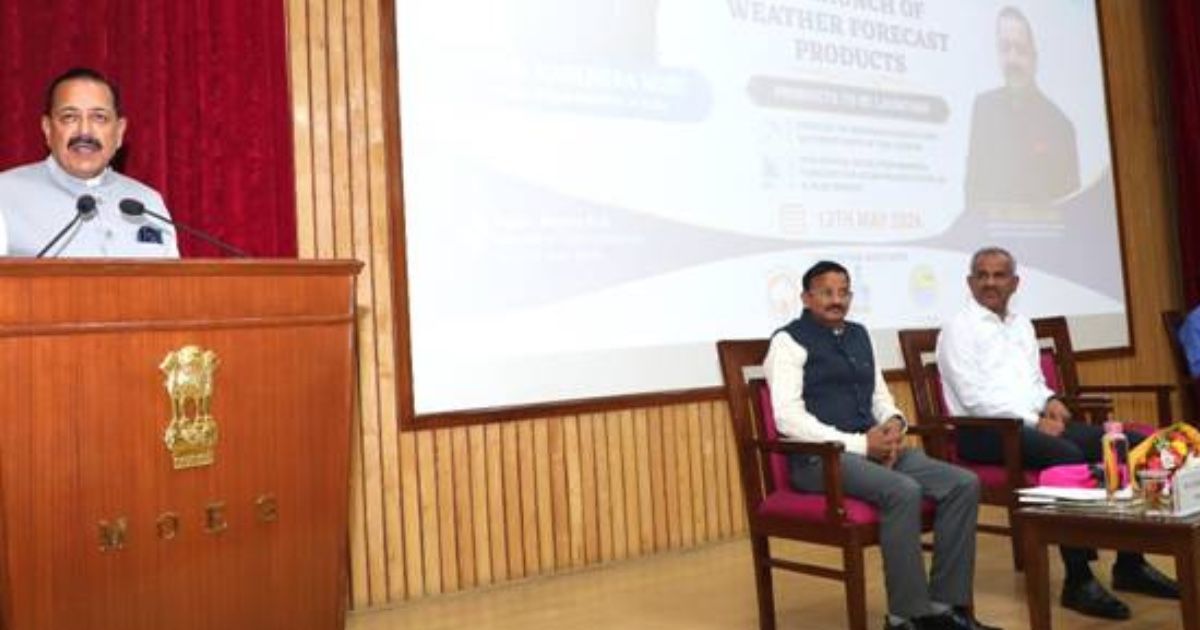
India’s weather forecasting system is set for a major technological upgrade after the Ministry of Earth Sciences launched two new artificial intelligence-based forecasting services aimed at improving the accuracy and reach of monsoon predictions.
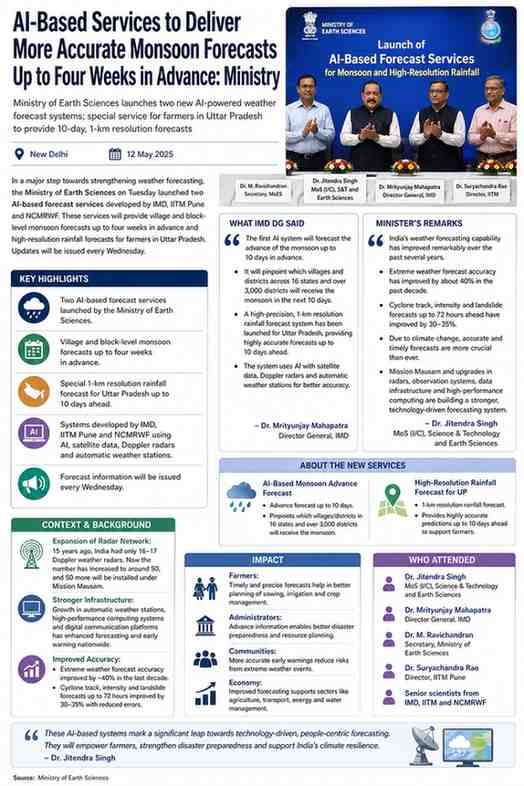
The services, introduced in New Delhi on Monday, will provide village- and block-level monsoon forecasts up to four weeks in advance. A separate high-resolution rainfall forecasting system has also been launched specifically for Uttar Pradesh, offering predictions up to 10 days ahead at a one-kilometre resolution.
The initiative has been jointly developed by the India Meteorological Department (IMD), the Indian Institute of Tropical Meteorology (IITM), Pune, and the National Centre for Medium Range Weather Forecasting (NCMRWF).
AI to Strengthen Monsoon Prediction Accuracy
According to IMD Director General Dr. Mrityunjay Mahapatra, one of the newly launched AI systems can predict the movement and advance of the southwest monsoon up to 10 days ahead.
The system is expected to help identify which districts and villages across 16 states are likely to receive monsoon rainfall during the forecast period. Officials said this could help farmers, local administrations and disaster management agencies prepare in advance for changing weather conditions.
The ministry also launched a dedicated rainfall forecasting model for Uttar Pradesh. The model uses one-kilometre resolution mapping to generate more localised rainfall predictions for up to 10 days.
Forecast updates from these systems will be issued every Wednesday.
Use of AI, Satellite Data and Radar Technology
Officials said the new forecasting platforms combine artificial intelligence with data gathered from satellites, Doppler weather radars and automatic weather stations.
The integration of these technologies is aimed at improving forecast precision, especially during extreme weather events and monsoon variability.
The government said the systems are designed to support agriculture, water management, disaster preparedness and local planning.
Government Highlights Expansion of Weather Infrastructure
Speaking at the launch event, Union Minister of State (Independent Charge) for Science and Technology and Earth Sciences, Dr. Jitendra Singh, said India’s weather forecasting capabilities have improved significantly over the past decade.
He noted that India had only around 16 to 17 Doppler weather radars nearly 15 years ago. The number has now increased to about 50, with another 50 planned under the Centre’s Mission Mausam programme.
According to the minister, improvements in radar networks, observation systems, high-performance computing and digital communication infrastructure have contributed to better early warning systems nationwide.
Dr. Singh said forecast accuracy for extreme weather events has improved by nearly 40 per cent over the past decade. He added that predictions related to cyclone paths, cyclone intensity and landslides up to 72 hours in advance have improved by around 30 to 35 per cent.
Why the New Forecast Systems Matter
India’s agriculture sector remains heavily dependent on monsoon rainfall, particularly in rural regions where farming activities rely on seasonal weather patterns.
More accurate and localised forecasts can help farmers make timely decisions related to sowing, irrigation and crop protection. Early warnings may also support disaster management agencies during heavy rainfall, floods and extreme weather events.
The government said the systems are especially important as climate change continues to increase the frequency and intensity of unpredictable weather conditions.
Mission Mausam and Technology-Led Forecasting
The launch forms part of the Centre’s broader push to modernise India’s weather and climate infrastructure through Mission Mausam.
The programme focuses on expanding radar coverage, strengthening observational networks, modernising communication systems and increasing computing capacity for faster and more accurate forecasting.
Officials said the adoption of AI-based forecasting tools represents a shift toward technology-driven weather services designed to deliver more precise information at the local level.
Next Steps
The Ministry of Earth Sciences said the new AI-based services will continue to be refined using real-time weather data and field observations.
Experts believe that if successfully implemented at scale, the systems could improve preparedness for monsoon-related disruptions while helping farmers and local authorities make better-informed decisions during the rainy season.
Inputs & Images: Hindusthan Samachar
Edited by: Pushkarini Annabathula
Also Read : CTET RESULT 2026 EXPECTED SOON: CBSE LIKELY TO ANNOUNCE FEBRUARY EXAM RESULTS ON OFFICIAL WEBSITE
Add republicpost.in as preferred source on google – Click Here
Last Updated on: Tuesday, May 12, 2026 8:12 pm by Pushkarini Annabathula | Published by: Pushkarini Annabathula on Tuesday, May 12, 2026 8:12 pm | News Categories: News
About The Author