India–New Zealand Free Trade Agreement Signed, Promises Duty-Free Access for Indian Exports
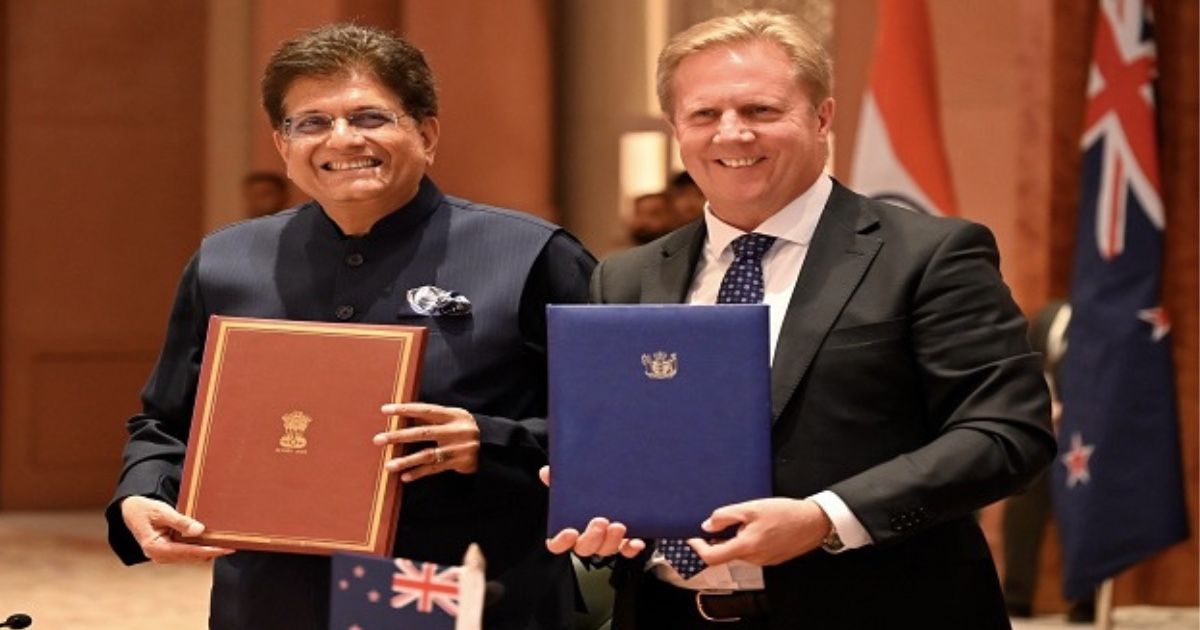
India and New Zealand have signed a bilateral Free Trade Agreement (FTA) in New Delhi on April 27, marking a significant step in strengthening economic ties between the two countries. The agreement was formalised by Piyush Goyaland Todd McClay, with both sides aiming to expand trade and investment cooperation.
Key Announcements / Highlights
- New Zealand will provide 100% duty-free access to all Indian exports.
- India will reduce or eliminate tariffs on around 70.03% of tariff lines.
- Bilateral trade is targeted to reach $5 billion within five years.
- Sensitive sectors such as dairy and certain agricultural products remain protected.
- The agreement includes a commitment to facilitate up to $20 billion in investment.
Duty-Free Access for Indian Exports
Under the agreement, Indian exports across all sectors will gain duty-free access to the New Zealand market. Key industries expected to benefit include textiles, garments, leather, footwear, jewellery, engineering goods, and processed foods.
Earlier, tariffs of up to 10% applied to several of these goods. Their removal is expected to improve price competitiveness and support export growth, particularly for micro, small and medium enterprises (MSMEs).
Indian manufacturers will also gain from cheaper imports of raw materials such as timber, coking coal, and scrap metal, which are used in production.
Official Statement
Officials from both countries described the agreement as a step towards expanding trade and economic cooperation. The pact aims to strengthen commercial ties, boost investment flows, and deepen collaboration in sectors such as services, technology, and skills development.
India’s Tariff Commitments
India has agreed to reduce or eliminate tariffs on a majority of imports from New Zealand, covering approximately 95% of import value. However, certain sectors have been excluded to protect domestic industries.
These include dairy products, select agricultural commodities such as onions and pulses, as well as items like sugar, fats, oils, and some metals. Tariff reductions on other goods—such as petroleum products, vegetable oils, and machinery—will be phased over periods ranging from three to ten years.
Products like wood, wool, sheep meat, and raw leather will see immediate tariff elimination, while others will benefit from gradual reductions.
Context / Background
A Free Trade Agreement is a pact between countries to reduce or remove trade barriers such as tariffs, making goods and services more competitive across borders. India has been expanding its network of FTAs as part of a broader strategy to increase exports and strengthen its role in global supply chains.
Trade between India and New Zealand currently stands at around $2.4 billion (2024), with scope for growth across goods and services sectors.
Public Impact
The agreement is expected to benefit Indian exporters by improving access to a developed market and enhancing competitiveness. MSMEs and labour-intensive sectors may see increased demand and job creation.
For consumers, tariff reductions could lead to greater availability of imported goods, although protections for sensitive sectors aim to prevent market disruptions.
The investment component may also contribute to infrastructure development, job opportunities, and technology transfer in the medium term.
The India–New Zealand FTA marks a new phase in bilateral economic relations, with both countries aiming to expand trade, investment, and cooperation. Implementation details and phased tariff reductions will shape how the agreement impacts businesses and consumers in the coming years.
Inputs & Images: Hindusthan Samachar
Edited by: Pushkarini Annabathula
Also Read : CTET RESULT 2026 EXPECTED SOON: CBSE LIKELY TO ANNOUNCE FEBRUARY EXAM RESULTS ON OFFICIAL WEBSITE
Add republicpost.in as preferred source on google – Click Here
Last Updated on: Monday, April 27, 2026 6:04 pm by Pushkarini Annabathula | Published by: Pushkarini Annabathula on Monday, April 27, 2026 6:04 pm | News Categories: Latest
About The Author