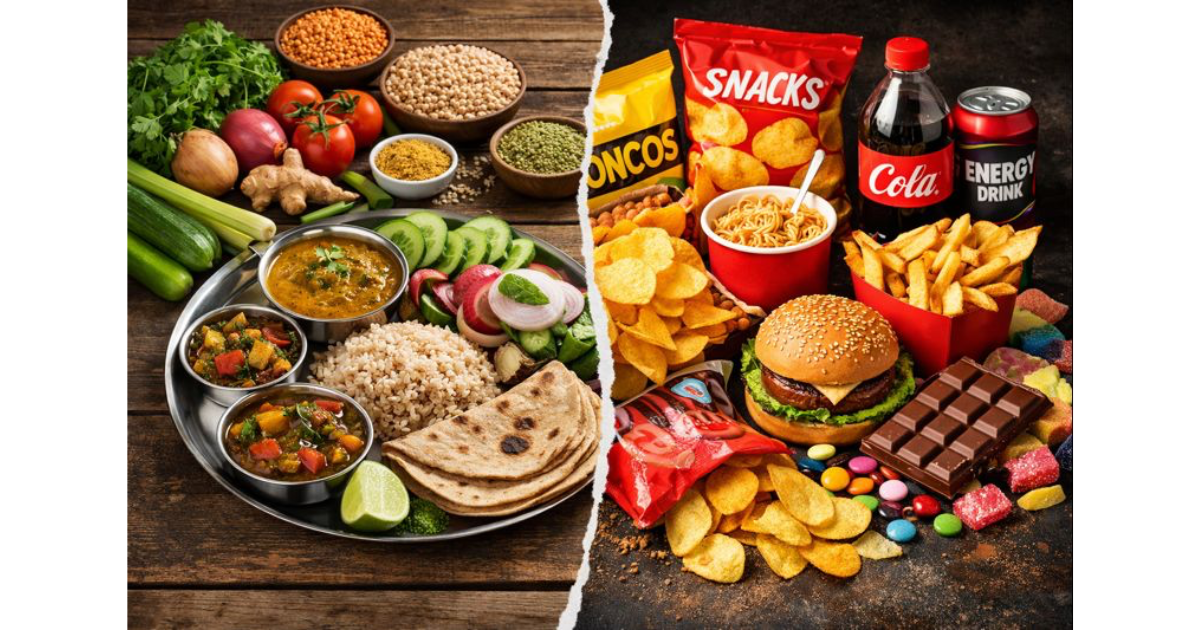
The Silent Crisis: Why Economic Survey 2026 Warns Against the Rising Consumption of Ultra-Processed Foods
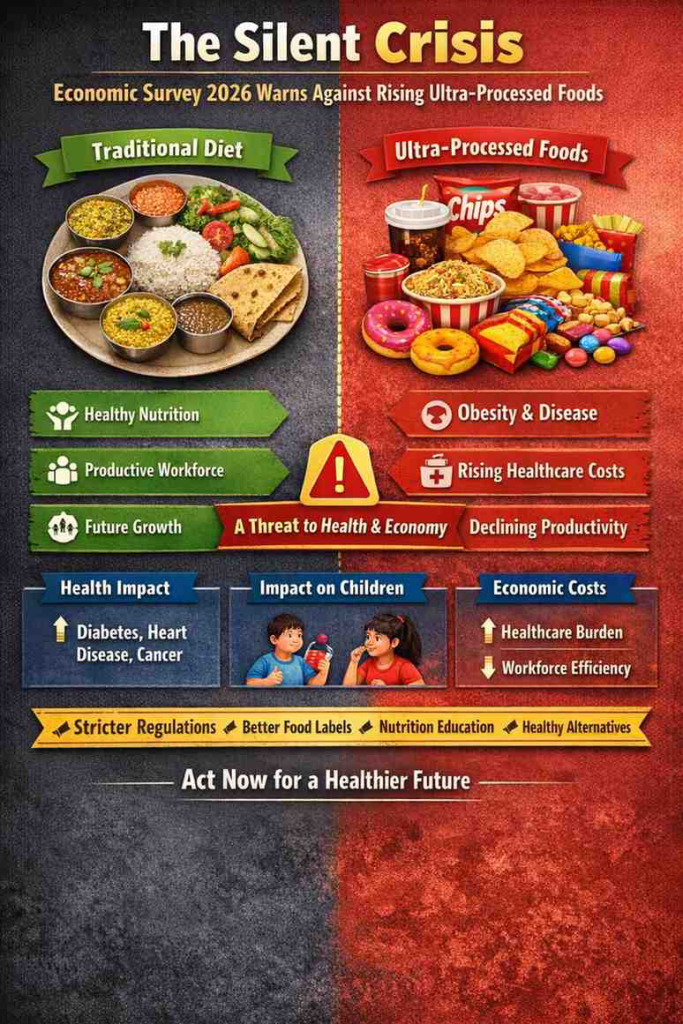
The Economic Survey 2026, often read for its insights into growth projections, fiscal discipline, and sectoral performance, carries an unusually stark warning this year—one that goes beyond balance sheets and GDP numbers. Buried within its analysis of human capital and productivity is a clear signal of concern over India’s rapidly changing food habits, particularly the growing dependence on ultra-processed foods. The Survey frames this not merely as a health issue but as a long-term economic risk capable of undermining workforce productivity, increasing healthcare costs, and weakening demographic dividends.
This warning marks a shift in how policymakers are beginning to view nutrition. Food choices, once treated as a personal or cultural matter, are now being acknowledged as a macroeconomic variable with deep and lasting consequences.
What Are Ultra-Processed Foods and Why Are They Spreading So Fast
Ultra-processed foods are industrial formulations made largely from refined ingredients, preservatives, artificial flavours, emulsifiers, and additives designed to enhance shelf life and palatability. Packaged snacks, sugary drinks, instant noodles, frozen meals, and ready-to-eat foods dominate this category. The Survey notes that urbanisation, rising incomes, time poverty among working households, and aggressive marketing have made these foods a default option for millions of Indians.
What makes the trend particularly alarming is its spread beyond metros. Improved supply chains, e-commerce platforms, and rural retail penetration have carried ultra-processed foods deep into small towns and villages, where traditional diets were once based on locally sourced grains, pulses, vegetables, and minimally processed foods. The Survey highlights that the speed of this dietary transition is faster in India than in many comparable economies.
Health Costs That the Economy Cannot Ignore
The Economic Survey 2026 draws a direct line between rising consumption of ultra-processed foods and the growing burden of non-communicable diseases. Obesity, Type 2 diabetes, cardiovascular ailments, hypertension, and certain cancers are increasingly affecting younger age groups. This is no longer a future concern; it is already visible in national health data and insurance claims.
From an economic perspective, the implications are severe. A workforce grappling with chronic illness is less productive, more frequently absent, and more dependent on healthcare systems. The Survey warns that if current dietary patterns continue, India could face a significant erosion of its labour efficiency just as it seeks to position itself as a global manufacturing and services hub.
The Impact on Children and the Future Workforce
One of the most troubling aspects highlighted in the Survey is the rising exposure of children to ultra-processed foods. School-age children and adolescents are increasingly consuming high-sugar, high-salt, and high-fat packaged foods, often replacing balanced home-cooked meals. The Survey links this trend to early onset obesity, micronutrient deficiencies, and impaired cognitive development.
This has long-term consequences that extend well beyond individual health. Poor childhood nutrition affects learning outcomes, skill acquisition, and future earning potential. The Economic Survey frames this as a threat to India’s demographic dividend, arguing that a young population alone is not enough—its health and nutritional quality are equally critical.
Corporate Food Systems and Regulatory Gaps
The Survey does not place the blame solely on consumer choices. It acknowledges the role of large-scale food processing corporations, marketing strategies targeted at children, and regulatory gaps in labelling and advertising. While India has food safety regulations, the Survey suggests that current frameworks do not adequately communicate the health risks associated with ultra-processed foods.
Misleading health claims, attractive packaging, and price competitiveness often create a false perception of convenience foods as harmless or even nutritious. The Survey subtly calls for stronger alignment between public health goals and food industry regulation without explicitly naming companies, signalling a cautious but firm policy stance.
Economic Inequality and the Nutrition Paradox
An important insight in the Economic Survey 2026 is the nutrition paradox emerging in India. While hunger and undernutrition persist in certain regions, obesity and diet-related diseases are rising across income groups. Ultra-processed foods, once considered aspirational, are now among the cheapest calorie sources available, making them attractive to low-income households.
The Survey warns that this dual burden of malnutrition and overnutrition could widen health inequalities. Poor households face higher exposure to unhealthy foods while having limited access to preventive healthcare, compounding economic vulnerability and intergenerational poverty.
Policy Signals and the Road Ahead
Although the Economic Survey is not a policy document, its warnings often foreshadow future government action. The strong language used to describe the risks of ultra-processed food consumption suggests that nutrition policy may soon move higher up the economic agenda. Possible responses hinted at include clearer front-of-pack labelling, tighter advertising norms, integration of nutrition awareness into public health missions, and incentives for the production and consumption of healthier food alternatives.
The Survey also emphasises the role of behavioural change, noting that regulation alone cannot reverse dietary trends. Public awareness, school-based nutrition education, and workplace wellness initiatives are identified as critical components of any long-term solution.
A Wake-Up Call Beyond the Kitchen
The Economic Survey 2026’s warning on ultra-processed foods is significant because it reframes the issue as a silent economic crisis rather than a lifestyle concern. It makes clear that what Indians eat today will shape the country’s healthcare costs, productivity levels, and growth potential tomorrow.
As India aspires to become a developed economy in the coming decades, the Survey reminds policymakers and citizens alike that sustainable growth depends not only on infrastructure, investment, and innovation, but also on the everyday choices made at the dining table. The message is unmistakable: ignoring the rise of ultra-processed foods could carry costs far greater than those reflected in the price printed on a packet.
Add republicpost.in as a preferred source on google – click here
Last Updated on: Tuesday, February 3, 2026 11:39 am by Rishidhar Reddy | Published by: Rishidhar Reddy on Tuesday, February 3, 2026 11:38 am | News Categories: News
About The Author