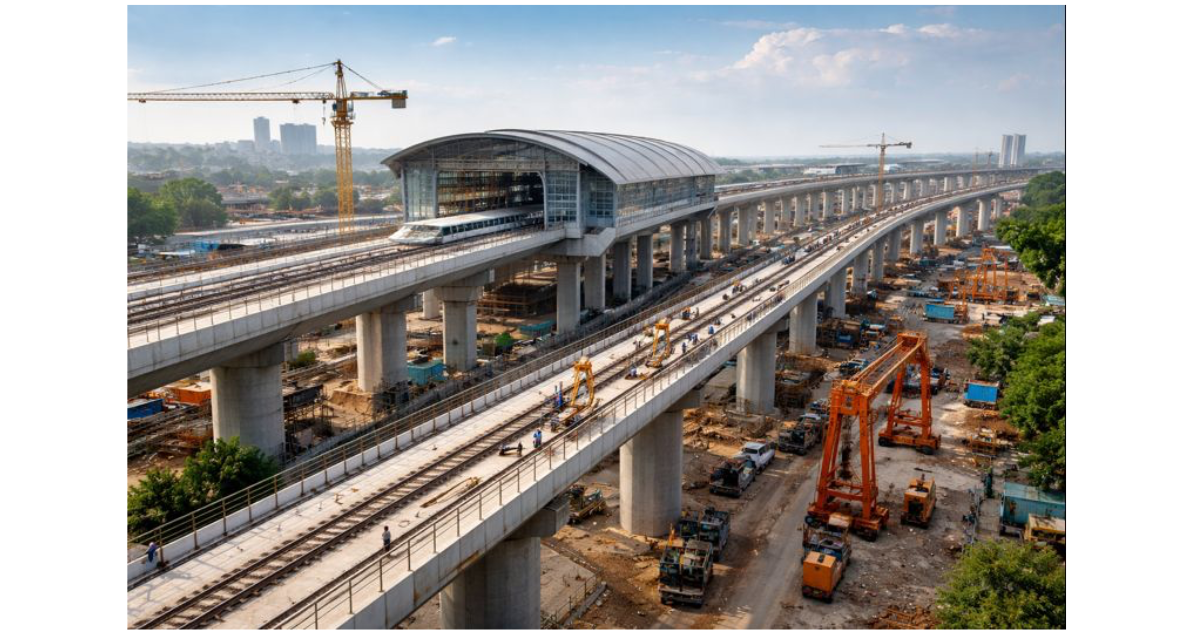
Backed by Japanese Shinkansen technology and executed by the National High Speed Rail Corporation Limited (NHSRCL), the project is widely seen as a test case for India’s ability to deliver complex, next-generation transport infrastructure at scale.Civil Works Gather Momentum Across Gujarat and MaharashtraThe strongest progress has been recorded along the Gujarat stretch of the corridor, where most land acquisition hurdles were resolved earlier, allowing construction to proceed at pace. Viaducts, piers, and foundations now dominate the landscape across districts such as Surat, Anand, and Vadodara, offering a tangible sense of how the high-speed corridor will reshape regional connectivity.In Maharashtra, where land acquisition initially faced delays, construction activity has accelerated over the past year. The completion of key packages, including underground sections near Mumbai and elevated corridors closer to Thane and Palghar, has helped bring the overall project past the halfway mark in physical terms.Officials note that the viaduct construction method, largely based on precast segments, has enabled faster execution while maintaining the precision required for trains operating at speeds exceeding 300 kmph.Key Stations Move From Structure to SystemsSeveral MAHSR stations have now progressed beyond basic civil structures and entered the systems installation phase, marking an important shift in the project lifecycle. Stations such as Surat, Anand, Vadodara, and Sabarmati are reported to be structurally complete or nearing completion, with internal works, platform finishing, roofing, and utilities underway.These stations are being designed not just as transit points but as integrated mobility hubs, featuring modern passenger amenities, seamless last-mile connectivity, and future-ready safety systems. With civil works largely in place at select locations, trial-readiness activities are beginning to take shape, including track alignment checks, platform interface planning, and preliminary systems testing.Track Laying and Electrical Systems Enter FocusOne of the most critical components of the project, track laying, has gained momentum along completed viaduct sections. The MAHSR corridor uses slab track technology, a departure from conventional ballast tracks, offering greater stability, reduced maintenance, and higher safety margins for high-speed operations.Parallel to track work, electrical and traction systems are also progressing. The overhead equipment, power substations, and advanced signalling architecture based on Japanese Automatic Train Control systems are being installed in phases. These systems are essential to ensuring operational safety at high speeds, especially in densely populated regions.Officials involved in the project indicate that the alignment between civil, electrical, and signalling works is now tighter than in earlier stages, helping reduce execution bottlenecks.Tunnels and the Mumbai ChallengeThe Mumbai end of the corridor remains one of the most technically complex segments of the MAHSR project. The underground station at Bandra-Kurla Complex, along with the long tunnel sections connecting to the elevated corridor, has required specialised construction techniques, including tunnel boring machines and deep excavation in urban conditions.Recent progress reports suggest steady advancement in tunnelling work, with key shafts and underground structures taking shape. While this section continues to pose engineering challenges, officials maintain that timelines have stabilised following earlier delays.Indigenisation and Skill Development Gain TractionBeyond physical construction, the bullet train project is increasingly being positioned as a catalyst for domestic capability building. A growing share of components, construction materials, and engineering services is now being sourced locally, aligning with broader industrial policy goals.Indian engineers and technicians trained in Japan have returned to take up leadership roles across various project segments, contributing to knowledge transfer in high-speed rail operations, maintenance, and safety protocols. Over time, this expertise is expected to support future high-speed rail corridors planned across the country.Preparing for the Trial PhaseWith select stations nearing readiness and continuous track sections becoming available, preparations for trial runs are gradually moving into focus. Initial trials will involve inspection vehicles and low-speed testing to validate track geometry, signalling response, and power systems before progressing to higher-speed tests.While full-scale commercial operations remain some distance away, officials describe the current phase as a psychological turning point for the project, where the shift from construction-heavy activity to system validation becomes visible.A Project With Long-Term Economic StakesThe MAHSR corridor is more than a transport project; it is a strategic infrastructure investment aimed at redefining inter-city mobility, reducing travel time between Mumbai and Ahmedabad to under three hours, and stimulating economic clusters along the route.Urban planners and industry stakeholders view the stations as future growth anchors, likely to influence real estate development, business travel, and regional tourism. As physical completion moves steadily upward, attention is also turning to how state governments and local authorities will integrate the bullet train into broader urban transport networks.Looking AheadCrossing 55 per cent physical completion places the MAHSR project firmly beyond the point of uncertainty that often shadows large infrastructure initiatives. While challenges remain, particularly in complex urban sections, the convergence of station readiness, track installation, and systems work signals that India’s first bullet train is steadily transitioning from blueprint to reality.For policymakers, engineers, and citizens alike, the coming months will be crucial in determining how quickly this momentum can translate into trial operations and, eventually, a new era of high-speed rail travel in India.