West Bengal Government to End Religion-Based Welfare Schemes From June
New BJP Government Announces Major Policy Shift After Taking Office in Bengal
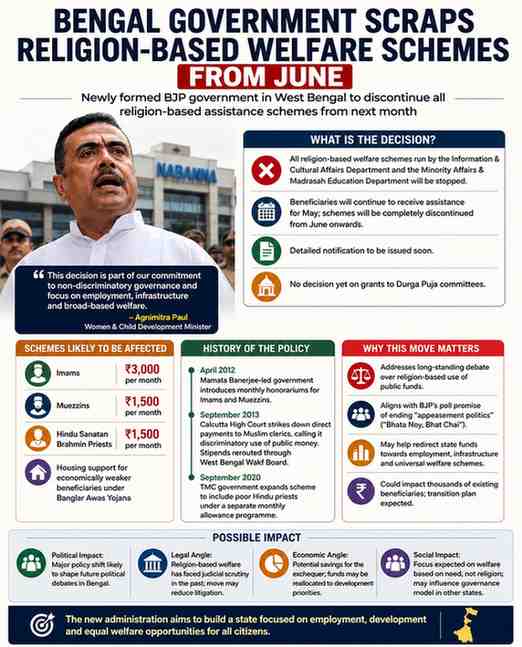
The newly formed West Bengal government led by Suvendu Adhikari has announced that religion-based welfare schemes in the state will be discontinued from June, marking one of the biggest policy decisions taken by the administration since assuming office.
The decision was taken during the second cabinet meeting of the new government held at Nabanna on Monday.
Addressing reporters after the meeting, Women and Child Development Minister Agnimitra Paul said that welfare assistance schemes operated on the basis of religion under the Information and Cultural Affairs Department and the Minority Affairs and Madrasah Education Department would be stopped from next month.
According to the minister, beneficiaries will continue receiving support for May, but the schemes will end completely from June onward.
The government is expected to release a detailed official notification soon.
Government Yet to Decide on Durga Puja Grants
While announcing the decision, the minister clarified that no final decision has yet been taken regarding grants provided to Durga Puja committees in the state.
The issue is likely to attract attention because Durga Puja funding and festival-related grants have remained politically sensitive topics in West Bengal over the last several years.
Officials have not yet clarified whether festival-linked cultural assistance schemes will be reviewed separately.
What Schemes Are Likely to Be Affected
Political observers believe the move could impact several welfare programmes introduced during the tenure of former Chief Minister Mamata Banerjee.
These include monthly honorariums provided to:
- Imams
- Muezzins
- Hindu priests
Under the previous system:
- Imams reportedly received ₹3,000 per month
- Muezzins received ₹1,500 per month
- Hindu Sanatan Brahmin priests received ₹1,500 per month
Some economically weaker beneficiaries were also linked to housing support programmes under Banglar Awas Yojana.
The government has indicated that future welfare planning may focus on broader economic and social categories instead of religion-based assistance structures.
Background of the Controversial Welfare Policy
The origins of the policy date back to 2012 when the Mamata Banerjee-led government introduced monthly honorariums for Imams and Muezzins.
The decision triggered political debate and legal scrutiny soon after implementation.
In 2013, the Calcutta High Court struck down the direct payment system for Muslim clerics, observing that taxpayer money could not be distributed in a discriminatory manner for a specific religious community.
Following the court order, the state government reportedly routed the payments through the West Bengal Wakf Board.
Later, amid criticism from Opposition parties, particularly the BJP, the Trinamool Congress government expanded assistance in 2020 to include poor Hindu priests through a separate allowance scheme.
BJP Calls Decision Part of ‘Non-Discriminatory Governance’
The BJP has consistently criticised religion-linked welfare schemes in West Bengal, describing them as examples of “appeasement politics.”
During the Assembly election campaign, BJP leaders repeatedly argued that the state should focus more on:
- Employment generation
- Infrastructure development
- Economic growth
- General welfare schemes
rather than religion-based financial assistance.
The party also used the slogan “Bhata Noy, Bhat Chai,” emphasizing livelihood and jobs over direct cash support programmes.
Government officials now say the administration intends to focus on welfare measures not linked to religious identity.
Political Significance of the Decision
The announcement is being viewed as one of the most politically significant administrative decisions taken by the new government within days of assuming power.
Political analysts say the move reflects:
- A major ideological shift in governance
- A new fiscal policy direction
- An attempt to redefine welfare priorities in the state
The decision is also likely to intensify political debate between the BJP and the Trinamool Congress in the coming months.
Supporters of the move argue that government assistance should be based on economic need rather than religion.
Critics, however, may question the impact on beneficiaries who depended on the honorarium schemes for financial support.
Economic and Administrative Angle
The government has indicated that the policy change is part of a broader administrative restructuring plan.
Officials claim the new approach aims to:
- Reduce financial pressure on the state
- Rationalise welfare spending
- Improve budget allocation efficiency
- Expand development-focused investment
Experts say welfare restructuring decisions often have long-term fiscal implications, especially in states managing large subsidy and support programmes.
However, economists also note that the overall financial impact will depend on how funds are reallocated and whether replacement welfare programmes are introduced.
Possible Legal and Political Discussions Ahead
Because religion-linked welfare policies in West Bengal have faced legal challenges in the past, experts believe the latest decision could also trigger fresh political and constitutional debate.
Issues likely to be discussed include:
- Equality in welfare distribution
- Secular governance principles
- Role of the state in religious assistance
- Fiscal policy priorities
The government’s detailed notification may provide further clarity on implementation and transition arrangements for affected beneficiaries.
What Happens Next
Attention will now shift to the official government order expected in the coming days.
The notification is likely to clarify:
- Which schemes will end
- Transition timelines
- Department-level implementation
- Impact on existing beneficiaries
Political parties are also expected to respond strongly as the issue may become a major topic in future Assembly debates and public campaigns.
For now, the decision marks a major policy change in West Bengal’s welfare structure and signals the BJP government’s effort to reshape governance priorities soon after taking office.
Key Insights
- The decision marks one of the most significant welfare policy reversals in West Bengal in recent years and reflects the BJP government’s effort to reshape the state’s administrative and fiscal priorities soon after assuming power.
- Religion-linked welfare schemes in West Bengal have remained politically controversial for more than a decade, particularly after the introduction of stipends for Imams and Muezzins in 2012 under the previous Trinamool Congress government.
- The policy change also revives constitutional and legal debates around the use of public funds for religion-specific financial assistance, an issue previously examined by the Calcutta High Court in 2013.
- By signalling a shift toward welfare schemes based on broader economic and social categories rather than religious identity, the new government appears to be aligning its governance approach with its long-standing political position against what it describes as “appeasement politics.”
- The move could have wider political implications because religion-based welfare schemes had become symbolic issues in West Bengal’s electoral discourse, frequently used by both the BJP and Trinamool Congress to mobilise support bases.
- Economically, the restructuring may allow the government to redirect funds toward infrastructure, employment generation, and universal welfare programmes, though the actual fiscal impact will depend on future budget allocations and replacement policies.
- The decision may also affect thousands of existing beneficiaries who depended on monthly honorariums, potentially creating administrative and social challenges during the transition period after the schemes are withdrawn.
- Political analysts believe the policy could influence future debates on secularism, welfare distribution, and state funding models not only in West Bengal but also in other states where religion-linked assistance programmes exist in different forms.
Inputs & Images: Hindusthan Samachar
Edited by: Pushkarini Annabathula
Also Read : CTET RESULT 2026 EXPECTED SOON: CBSE LIKELY TO ANNOUNCE FEBRUARY EXAM RESULTS ON OFFICIAL WEBSITE
Add republicpost.in as preferred source on google – Click Here
Last Updated on: Monday, May 18, 2026 5:35 pm by Pushkarini Annabathula | Published by: Pushkarini Annabathula on Monday, May 18, 2026 5:33 pm | News Categories: Latest
About The Author