
The Strategic Value of Personal Branding for Founders in a Competitive Venture Capital Environment
In today’s venture capital ecosystem, the identity of the founder has become inseparable from the investment case itself. As global and Indian venture markets mature and capital becomes more discerning, personal branding has quietly evolved from a peripheral concern into a strategic asset that influences how founders are evaluated, trusted, and ultimately funded.
The venture capital environment entering 2026 is defined less by a shortage of capital and more by heightened selectivity. While funding continues to flow into innovation-led sectors such as artificial intelligence, fintech infrastructure, and enterprise software, investors are concentrating their bets on fewer companies with clearer paths to sustainable growth. This shift has altered how risk is assessed. Beyond market size and product differentiation, investors are placing greater emphasis on founder credibility, decision-making maturity, and the ability to navigate prolonged uncertainty.
In this context, personal branding has emerged as a mechanism through which founders signal these qualities long before a formal pitch takes place. A founder’s public presence—across industry discussions, thought leadership, and professional networks—now acts as a continuous form of due diligence. Investors increasingly observe how founders articulate their vision, respond to industry changes, and engage with stakeholders over time, using these signals to form early judgments about leadership quality and execution potential.
Unlike traditional marketing, personal branding in the venture context is not about visibility for its own sake. Its strategic value lies in trust-building. Venture capital has always been a relationship-driven business, but the compression of decision timelines and the sheer volume of opportunities have elevated the importance of trust shortcuts. A consistent and credible founder narrative reduces information asymmetry, helping investors gain confidence more quickly in a founder’s competence and integrity.
This dynamic is particularly relevant in competitive fundraising cycles, where many startups appear similar on paper. Comparable traction metrics, overlapping technology stacks, and converging business models make differentiation difficult. In such environments, founders themselves often become the primary point of distinction. A well-established personal brand helps investors remember not just the company, but the reasoning, discipline, and values behind it.
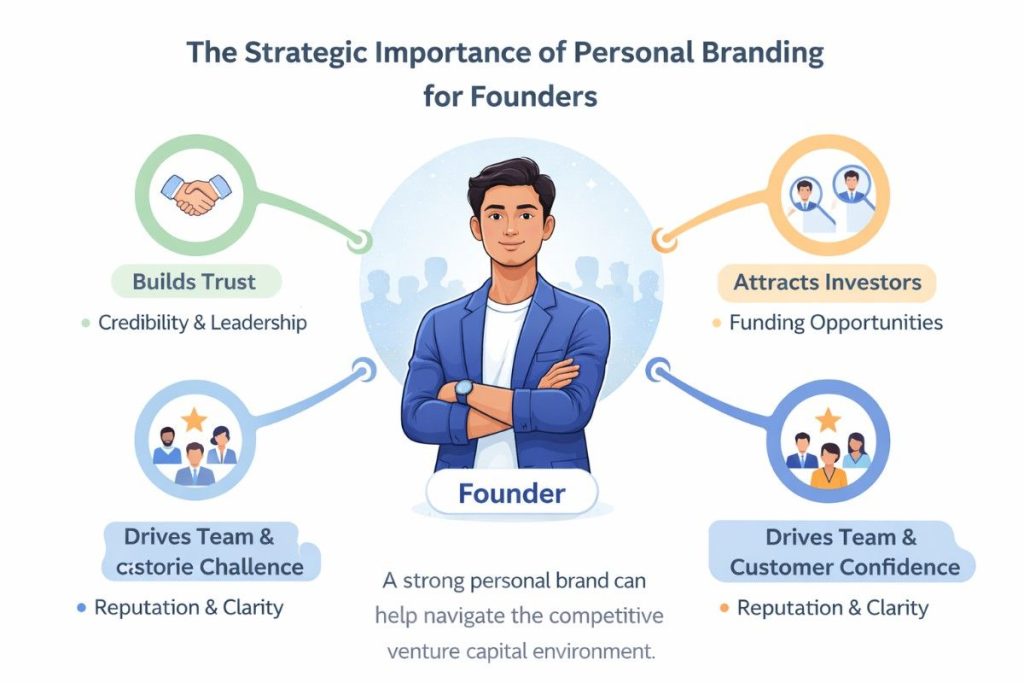
Personal branding also reshapes the quality of opportunities that come inbound. Founders with a clear professional identity tend to attract investors, advisors, and partners who are aligned with their domain and long-term vision. Rather than increasing the volume of conversations, effective personal branding improves their relevance. This alignment reduces friction during fundraising and can accelerate decision-making, as conversations begin with shared context rather than basic validation.
The influence of founder reputation extends beyond fundraising. Hiring senior talent, forming enterprise partnerships, and securing early customers increasingly depend on trust in leadership. In markets where startups must demonstrate capital efficiency and resilience, stakeholders want reassurance that the people in charge can make sound trade-offs under pressure. A credible personal brand reinforces that confidence and supports the broader operating environment of the company.
Importantly, personal branding gains its power from substance rather than performance. Investors are highly sensitive to inconsistencies between public narratives and private realities. Overstated claims, trend-driven positioning, or visibility unsupported by execution can quickly erode trust. In contrast, founders who communicate with clarity, restraint, and intellectual honesty tend to build reputational equity that compounds over time.
That reputational equity becomes especially valuable during periods of adversity. Missed targets, delayed launches, or macroeconomic shocks are inevitable in venture-backed companies. Founders with established trust are better positioned to retain investor support, maintain team morale, and preserve strategic flexibility during such moments. In this sense, personal branding functions as a form of reputational insurance, cushioning the impact of short-term setbacks.
As venture capital markets continue to evolve, the role of the founder is expanding. Founders are no longer evaluated solely as builders of products, but as stewards of capital, culture, and long-term narrative. Personal branding, when grounded in genuine expertise and consistent behavior, enables founders to make their judgment visible and their credibility durable.
In an era where capital is cautious, attention is scarce, and competition is intense, personal branding has become part of the strategic infrastructure of company building. It is not a substitute for product-market fit or execution, but it increasingly determines how quickly those strengths are recognized. For founders navigating a competitive venture capital environment, reputation is no longer intangible. It is an asset—earned slowly, tested continuously, and valued highly when decisions matter most.
Also Read : The Rise of Sustainable Unit Economics: Why Indian Investors Are Prioritizing Systems Thinking Over Growth
Add republicpost.in as preferred source on google – Click Here
Last Updated on: Thursday, February 5, 2026 11:33 am by Republic Post Team | Published by: Republic Post Team on Thursday, February 5, 2026 11:33 am | News Categories: Startup, Trending
About Us: Republic Post covers the latest News on Current News, Business, Sports, Tech, Entertainment, Lifestyle, Automobiles, and more, led by Editor-in-Chief Ankur Srivastava. Stay connected on Facebook, Instagram, LinkedIn, X (formerly Twitter), Google News, and Whatsapp Channel.
Disclaimer: At Republic Post, we are committed to providing accurate, reliable, and thoroughly verified information, sourced from trusted media outlets. For more details, please visit our About, Disclaimer, Terms & Conditions, and Privacy Policy. If you have any questions, feedback, or concerns, feel free to contact us through email.
Contact Us: rishidharqitech@gmail.com
About The Author

