
Biopharma SHAKTI Scheme: What You Should Know About India’s New ₹10,000 Crore Healthcare Manufacturing Push
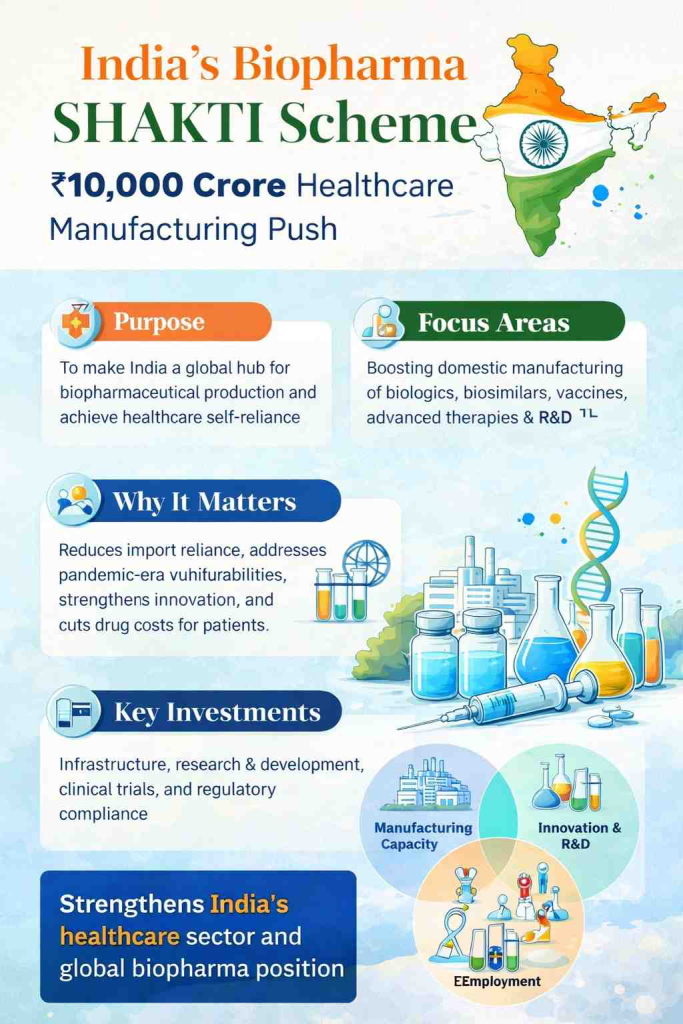
India is taking another decisive step toward strengthening its healthcare manufacturing ecosystem with the launch of the Biopharma SHAKTI Scheme, a ₹10,000 crore government-backed initiative aimed at transforming the country into a global hub for biopharmaceutical production. At a time when geopolitical disruptions, pandemic lessons, and supply chain vulnerabilities have reshaped global healthcare priorities, the scheme signals New Delhi’s intent to move decisively from dependence to dominance in critical biopharma segments.
The initiative aligns with the broader vision of Atmanirbhar Bharat, but its scope goes far beyond import substitution. It seeks to position India not just as the “pharmacy of the world” for generics, but as a serious contender in advanced biologics, vaccines, biosimilars, and complex therapeutic products.
Why the Biopharma SHAKTI Scheme Matters Now
The timing of the Biopharma SHAKTI Scheme is significant. Despite India’s strong pharmaceutical base, the country continues to rely heavily on imported active pharmaceutical ingredients, advanced biologics inputs, and high-end manufacturing technologies. The COVID-19 pandemic exposed these vulnerabilities, particularly in areas such as vaccines, biologics, and critical raw materials.
Global demand for biopharmaceuticals is expanding rapidly, driven by aging populations, rising chronic diseases, and breakthroughs in biotechnology. India’s share in this high-value segment has remained modest compared to its potential. The SHAKTI scheme is designed to close that gap by creating a robust manufacturing, research, and innovation ecosystem that can compete with established global players.
What the ₹10,000 Crore Investment Is Aimed At
The financial outlay under the Biopharma SHAKTI Scheme is expected to be deployed across multiple layers of the value chain. The focus is on scaling up domestic manufacturing capacity for biologics, biosimilars, vaccines, cell and gene therapies, and other complex biologic drugs. Infrastructure development, technology upgradation, and support for greenfield and brownfield projects form the backbone of the scheme.
In addition to manufacturing, the scheme places emphasis on strengthening research and development capabilities. This includes support for clinical trials, quality testing infrastructure, and compliance with global regulatory standards such as those of the US FDA and the European Medicines Agency. By addressing both production and regulatory readiness, the government aims to ensure that Indian-made biopharma products are globally competitive.
Boosting Innovation and Industry Participation
One of the defining features of the Biopharma SHAKTI Scheme is its focus on innovation-driven growth rather than volume-led expansion alone. The initiative is expected to encourage greater participation from private industry, startups, and research institutions, fostering collaboration between academia and manufacturers.
By reducing entry barriers for high-capital, high-risk biopharma projects, the scheme aims to attract investments into cutting-edge areas that have traditionally been dominated by multinational corporations. For Indian companies, this could mean a shift from contract manufacturing to ownership of intellectual property, patented therapies, and globally marketed biologics.
Employment, Skills, and the Talent Pipeline
Beyond manufacturing output, the scheme is likely to have a significant impact on employment and skill development. Biopharmaceutical production requires highly trained scientists, engineers, regulatory experts, and quality assurance professionals. As new facilities come online, demand for specialized talent is expected to rise sharply.
This, in turn, could catalyze improvements in biotechnology education, industry-linked training programs, and research careers within India. Over time, the scheme may help stem the brain drain of skilled biopharma professionals by creating globally competitive opportunities at home.
Implications for Patients and Healthcare Access
For Indian patients, the long-term benefits of the Biopharma SHAKTI Scheme could be substantial. Increased domestic production of biologics and biosimilars has the potential to lower treatment costs for diseases such as cancer, autoimmune disorders, and rare conditions, where therapies are currently expensive and often imported.
Greater control over supply chains also improves drug availability and resilience during global disruptions. As India builds capacity in advanced therapies, patients could gain faster access to next-generation treatments without the delays and costs associated with imports.
India’s Global Ambitions in Biopharma
On the international stage, the scheme strengthens India’s ambition to become a trusted global supplier of high-quality biopharmaceutical products. As countries look to diversify supply chains away from concentrated manufacturing hubs, India’s scale, scientific talent, and regulatory experience offer a compelling alternative.
If implemented effectively, the Biopharma SHAKTI Scheme could help India move up the global pharmaceutical value ladder, from being a cost-efficient producer to a center of innovation and advanced healthcare manufacturing.
Challenges That Will Define Its Success
While the intent is ambitious, execution will be critical. Biopharma manufacturing is capital-intensive, technology-driven, and heavily regulated. Delays in approvals, infrastructure bottlenecks, or insufficient coordination between agencies could dilute the scheme’s impact.
Equally important will be sustained policy support, transparency in incentives, and alignment with state governments, which play a key role in land, utilities, and local regulations. The success of SHAKTI will depend not only on funding but on creating an ecosystem that rewards quality, innovation, and global competitiveness.
A Defining Moment for India’s Healthcare Manufacturing
The Biopharma SHAKTI Scheme represents a pivotal moment for India’s healthcare and pharmaceutical sectors. With ₹10,000 crore committed to building future-ready capabilities, the government is placing a long-term bet on science, innovation, and strategic autonomy.
If the momentum is maintained and implementation matches ambition, the scheme could redefine India’s position in the global biopharmaceutical landscape, delivering economic growth, high-value jobs, and more affordable advanced healthcare for millions.
Add republicpost.in as a preferred source on google – click here
Last Updated on: Thursday, February 5, 2026 11:14 am by Rishidhar Reddy | Published by: Rishidhar Reddy on Thursday, February 5, 2026 11:13 am | News Categories: Health
About Us: Republic Post covers the latest News on Current News, Business, Sports, Tech, Entertainment, Lifestyle, Automobiles, and more, led by Editor-in-Chief Ankur Srivastava. Stay connected on Facebook, Instagram, LinkedIn, X (formerly Twitter), Google News, and Whatsapp Channel.
Disclaimer: At Republic Post, we are committed to providing accurate, reliable, and thoroughly verified information, sourced from trusted media outlets. For more details, please visit our About, Disclaimer, Terms & Conditions, and Privacy Policy. If you have any questions, feedback, or concerns, feel free to contact us through email.
Contact Us: rishidharqitech@gmail.com
About The Author
