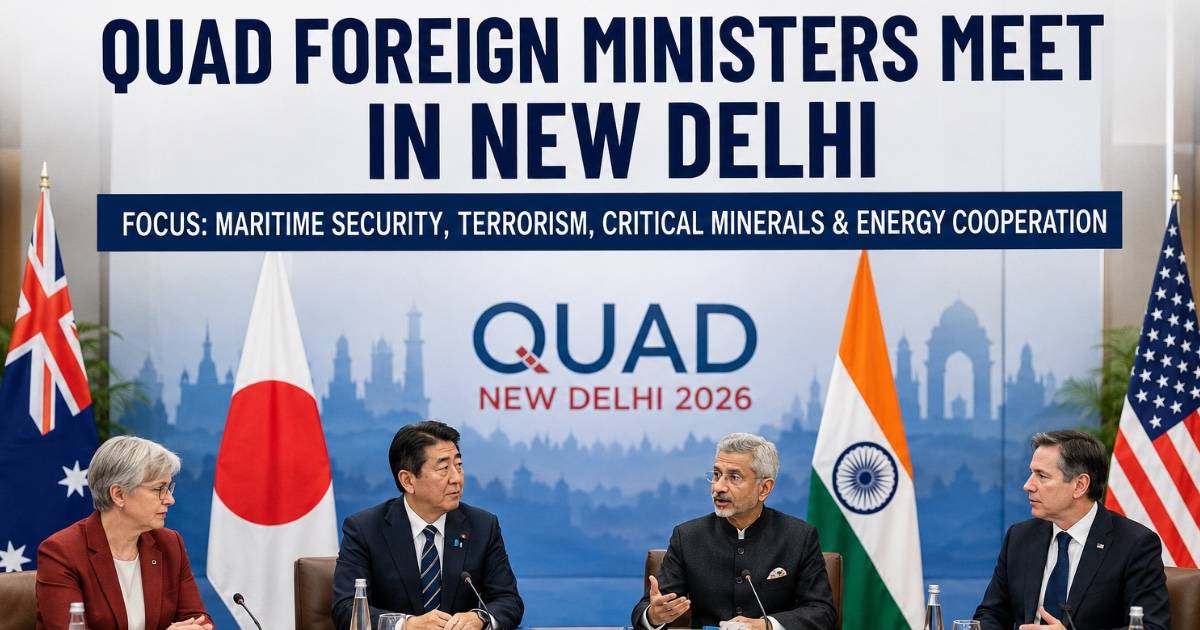
Quad Foreign Ministers Meet In New Delhi
India Hosts Key Quad Meeting As Leaders Focus On Security, Energy Cooperation, Critical Minerals, And Regional Stability
New Delhi has become the center of global diplomatic attention as India hosts an important meeting of Quad foreign ministers involving India, the United States, Japan, and Australia. The high-level gathering is being closely watched by policymakers, strategic experts, and international observers because of its potential impact on regional security, economic cooperation, and the future geopolitical balance in the Indo-Pacific region.
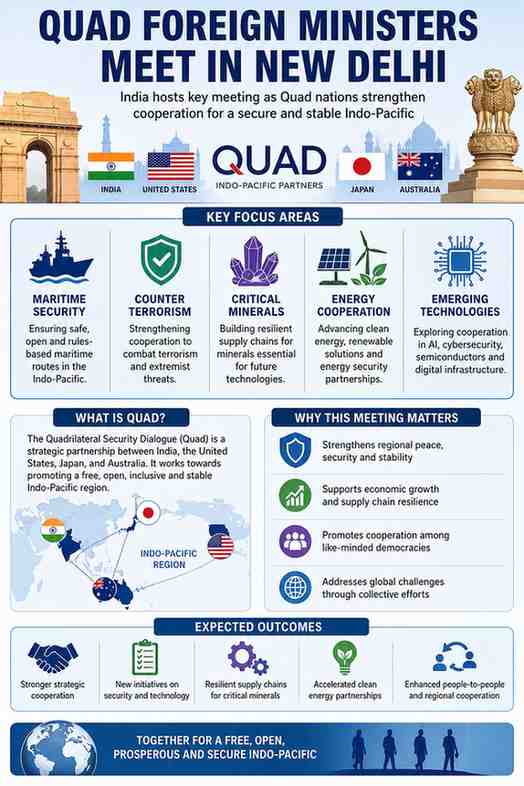
The meeting has emerged as one of the most significant international stories today, generating strong interest across global media platforms. Discussions are expected to focus on several critical issues including maritime security, terrorism, critical mineral supply chains, energy cooperation, emerging technologies, and strategic stability.
As international relations increasingly become shaped by shifting alliances and regional challenges, the Quad grouping continues to gain attention as an important platform for cooperation among major democracies.
The Quad, formally known as the Quadrilateral Security Dialogue, includes India, the United States, Japan, and Australia. Over recent years, the grouping has evolved into an influential diplomatic partnership focused on promoting a free, open, and stable Indo-Pacific region.
While the Quad is not a military alliance, analysts say its growing importance reflects broader strategic developments taking place across Asia and beyond.
The latest meeting in New Delhi arrives at a time when geopolitical discussions around maritime routes, economic resilience, technological cooperation, and global security have become increasingly important.
Foreign ministers from the participating nations are expected to exchange views on a range of pressing international concerns.
One major area receiving attention is maritime security.
The Indo-Pacific region remains one of the world’s most strategically important areas because of its major shipping routes and economic significance. A large percentage of global trade passes through these waters, making regional stability essential for international commerce.
Security experts have repeatedly emphasized the importance of maintaining open sea lanes and ensuring uninterrupted movement of trade.
As economic activity across Asia continues expanding, maritime discussions increasingly occupy a central place within diplomatic conversations.
Analysts believe the New Delhi meeting could further strengthen cooperation among Quad nations on regional maritime initiatives.
Another important issue under discussion is terrorism.
Counterterrorism cooperation remains a major international priority.
Countries worldwide continue facing concerns related to cross-border security threats, extremist activities, cyber risks, and evolving forms of international security challenges.
Diplomatic platforms such as Quad meetings often provide opportunities for participating countries to discuss coordination strategies and information sharing mechanisms.
Experts say strengthening international cooperation remains essential because security threats increasingly operate beyond national boundaries.
The issue of critical minerals has also become one of the meeting’s major talking points.
Critical minerals play a crucial role in modern industries and emerging technologies.
These materials are essential for:
- Electric vehicle batteries
- Renewable energy systems
- Semiconductor manufacturing
- Telecommunications technology
- Defense systems
- Advanced electronics
- Clean energy infrastructure
Global demand for critical minerals has grown rapidly in recent years due to increasing investment in clean technologies and digital infrastructure.
Governments worldwide are attempting to diversify supply chains and reduce vulnerabilities linked to strategic resources.
Analysts believe supply chain resilience has become one of the most important economic discussions globally.
Several countries are now exploring partnerships that can improve access to strategic materials while reducing dependence on limited supply sources.
Because of this, critical mineral cooperation has become a major diplomatic and economic priority.
Energy security is another major issue expected to receive significant attention during discussions.
Global energy markets have experienced multiple disruptions over recent years due to international conflicts, changing demand patterns, climate-related concerns, and broader economic developments.
Countries increasingly seek stable energy partnerships and diversified energy strategies.
Energy discussions now frequently include both traditional and renewable sectors.
Governments are also focusing on:
- Clean energy transition
- Sustainable infrastructure
- Green technologies
- Energy supply resilience
- Climate-related cooperation
- Technological innovation
Experts believe energy cooperation could become an increasingly important pillar of future international partnerships.
Beyond policy discussions, the meeting also reflects India’s expanding role in global diplomacy.
India’s international influence has grown significantly in recent years as it continues strengthening relationships across multiple regions.
Hosting high-profile international meetings further reinforces India’s position as an important diplomatic actor in global affairs.
Political observers note that India increasingly plays a role in discussions involving economic development, strategic cooperation, technology partnerships, and regional stability.
The New Delhi meeting therefore carries symbolic significance beyond immediate policy outcomes.
It also reflects broader changes occurring within international diplomacy.
Global strategic relationships increasingly involve flexible partnerships built around shared interests rather than traditional structures.
Quad cooperation is often viewed within this evolving diplomatic framework.
Another reason the meeting has attracted attention is growing public curiosity around geopolitical developments.
International relations stories increasingly generate strong digital engagement, particularly when they involve major countries and strategic issues.
Search terms related to:
- Quad meeting today
- India US relations
- Indo-Pacific news
- Quad summit update
- maritime security
- India foreign policy
- critical minerals
- global diplomacy
have gained online interest.
YouTube explainers, policy channels, and social media discussions are also actively analyzing the significance of the meeting.
Short-form videos explaining “What is Quad?” and “Why Quad matters for India” have gained traction among younger audiences.
Digital audiences increasingly seek simplified explanations of complex global events.
This trend has encouraged publishers to create more accessible geopolitical content.
Experts say geopolitical stories now perform strongly when they connect international developments with domestic interests.
Readers increasingly want answers to practical questions such as:
How does this affect India?
Why does this meeting matter?
What are critical minerals?
How could international cooperation impact economic opportunities?
Such questions help drive online engagement.
Some analysts believe technology cooperation may also become an increasingly important area for Quad collaboration in future years.
Emerging technologies including artificial intelligence, cybersecurity systems, digital infrastructure, semiconductor manufacturing, and telecommunications continue shaping strategic discussions worldwide.
Technological competition increasingly overlaps with economic and national security discussions.
As a result, technology partnerships may receive greater diplomatic attention in coming years.
Meanwhile, international observers continue monitoring outcomes from the New Delhi discussions.
While diplomatic meetings often focus on long-term strategic goals rather than immediate announcements, they frequently help establish direction for future cooperation.
Experts note that multilateral dialogue remains important in an increasingly interconnected world.
Global challenges such as climate issues, technological disruptions, economic uncertainty, supply chain resilience, and security concerns often require coordinated responses.
Platforms such as Quad provide opportunities for countries to discuss shared interests and policy priorities.
As the meeting continues, analysts across geopolitical circles will closely monitor statements and developments emerging from New Delhi.
The gathering reflects not only immediate diplomatic priorities but also larger shifts reshaping global politics.
For India, the meeting further strengthens its role within major international conversations.
For the broader region, it highlights growing focus on security, resilience, and cooperation.
And for observers worldwide, today’s discussions may offer important signals regarding the future direction of international partnerships in an increasingly complex global environment.
Key Insights
- India hosted a high-level Quad Foreign Ministers meeting in New Delhi, bringing together representatives from India, the United States, Japan, and Australia.
- The meeting has become a major geopolitical story, attracting global attention due to its strategic significance.
- Maritime security emerged as a key discussion area, particularly around maintaining stability and secure trade routes in the Indo-Pacific region.
- Counterterrorism cooperation remains a major priority, with countries discussing regional and international security concerns.
- Critical minerals received strong focus, highlighting their growing importance in electric vehicles, clean energy systems, semiconductors, and advanced technology sectors.
- Governments are increasingly seeking diversified and resilient supply chains for strategic resources.
- Energy cooperation discussions are gaining importance, including renewable energy, sustainability, and long-term energy security.
- The meeting reflects India’s growing diplomatic influence and expanding global role in international affairs.
- Experts say the Quad has evolved into a significant platform for regional cooperation, despite not being a formal military alliance.
- The gathering highlights growing emphasis on a free, open, and stable Indo-Pacific region.
- Technology-related discussions including AI, cybersecurity, and digital infrastructure may play a larger role in future Quad cooperation.
- Search interest around terms like “Quad meeting today,” “India foreign policy,” and “Indo-Pacific news” is increasing online.
- Social media and YouTube explainers are driving curiosity among younger audiences about what Quad is and why it matters.
- Analysts believe the meeting could shape future international cooperation on security, economics, technology, and strategic partnerships.
- The discussions underline a broader shift toward flexible global partnerships built around shared interests and emerging challenges.
Last Updated on: Wednesday, May 27, 2026 3:08 pm by Pushkarini Annabathula | Published by: Pushkarini Annabathula on Wednesday, May 27, 2026 3:03 pm | News Categories: News, Latest
About The Author